

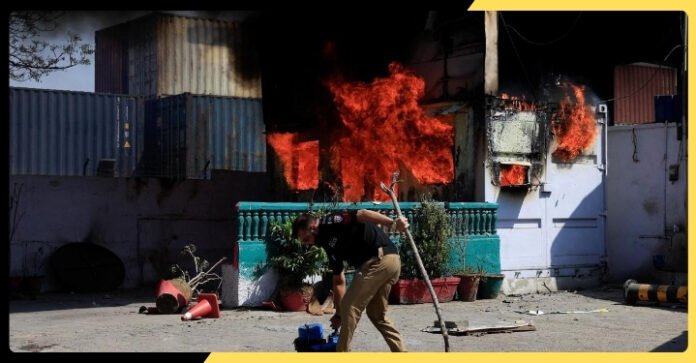

On Sunday, violent protests outside the U.S. Consulate in Karachi, Pakistan resulted in the deaths of at least eight people and injuries to more than 20 others, local rescue officials said. The unrest erupted when hundreds of pro-Iranian demonstrators attempted to storm the consular compound following a major U.S. and Israeli attack on Iranian territory that killed Iran’s Supreme Leader, Ayatollah Ali Khamenei.
According to Muhammad Amin, spokesman for the Edhi Foundation rescue service, most of those killed suffered bullet wounds as clashes with police and paramilitary forces intensified in the port city’s streets. The violence occurred near the consulate on Mai Kolachi Road, where young protesters scaled security fences and smashed windows at the perimeter before being confronted by tear gas and baton charges from law enforcement.
Videos circulating on social media showed chaotic scenes: smoke rising, shattered glass around the consulate entrance, and demonstrators chanting slogans against the United States and Israel. Witnesses reported that the protesters’ initial momentum was driven by anger over the Iranian leader’s death, which was widely shared across Pakistan’s Shiite Muslim minority that views Khamenei as a spiritual figure.
Police in Karachi said they responded with tear gas and other crowd control measures after protesters breached an outer driveway of the tough-secured compound. Although security forces eventually dispersed the crowd, the clashes highlighted the deep regional frustrations and volatile sentiments triggered by the broader Israel-Iran conflict.
In addition to Karachi, demonstrations also took place in other Pakistani cities. Thousands gathered in Lahore and Skardu, with protesters setting fire to a United Nations office in the Gilgit-Baltistan region before security forces restored order. Organizers also planned additional rallies near the diplomatic enclave in Islamabad later in the day.
The Pakistani government imposed heightened security around foreign missions and diplomatic zones, anticipating more protests as news of geopolitical developments spread. Western embassies and consulates across the country reviewed safety protocols for their staff and assets amid rising tensions.
Analysts say that these protests reflect how events in the Middle East can quickly influence public sentiment in South Asia, especially among populations with religious and ideological ties to regional powers. The incident underscores the complex interplay between domestic stability and international conflicts, posing challenges for Pakistan’s security apparatus as it balances diplomatic relations with internal public order.