

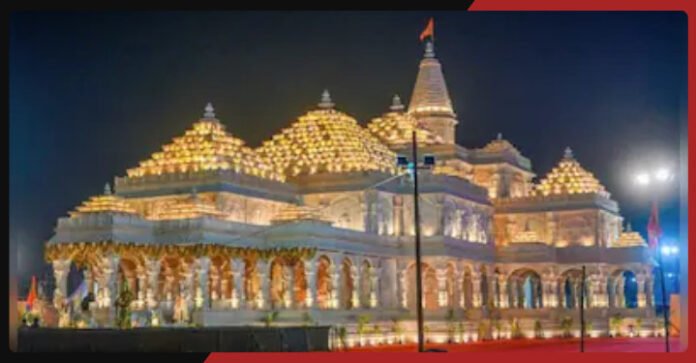

The selection process for the next Chief Executive Officer of the Ram Mandir in Ayodhya has entered a crucial stage, with shortlisted candidates now facing interviews that go beyond conventional questions about administration, management and leadership. According to reports, candidates appearing for the prestigious position were asked questions related to their personal religious practices, food habits, alcohol consumption and familiarity with Hindu traditions.
Questions reportedly included whether a candidate has faith in Lord Ram, whether they wear a janeu, whether they are vegetarian, whether they consume alcohol and whether they understand Hindu religious customs. Candidates were also asked whether they would be comfortable following traditional Hindu practices, including clothing expectations.
The questions have attracted considerable attention because the CEO position is not an ordinary administrative job. The person selected will be expected to manage the day-to-day functioning of one of India’s most prominent religious institutions while coordinating with the temple trust, pilgrims, officials, security agencies and other stakeholders.
The interview process comes after an unusually large response to the recruitment exercise. Reports earlier said more than 1,000 applications had arrived soon after the recruitment notification, while subsequent reports put the final number at around 5,200 applications. The large pool included experienced administrators and officers from different professional backgrounds.
Among the shortlisted candidates are three former IAS officers, one former IPS officer and four former military officers who appeared on the first day of interviews. The process was conducted at the temple complex, where candidates were also given an opportunity to see the facilities before their interviews.
The religious questions have become one of the most discussed aspects of the selection process. Supporters of such questions may view them as an attempt to determine whether candidates understand the cultural and religious environment in which the institution operates. The Ram Mandir is not simply a large public attraction; it is a religious institution whose administration involves rituals, traditions, devotees and religious sensitivities.
At the same time, the reported questions raise a broader question about how personal lifestyle choices should be considered when selecting a senior executive. Whether someone eats vegetarian food, wears a janeu or consumes alcohol does not automatically determine administrative ability. A CEO must also demonstrate competence in financial management, crowd management, crisis response, staff coordination, technology, transparency and long-term planning.
The selection committee therefore appears to be considering both dimensions. Reports say candidates were asked about leadership capacity, administrative experience, social and religious engagement, their understanding of the temple and their plans for its future.
The earlier application questionnaire also reportedly covered educational qualifications, administrative experience, leadership abilities, management of large events and the candidate’s vision for the Shri Ram Janmbhoomi Teerth Kshetra. This indicates that the selection process was designed to evaluate candidates on a broad range of criteria rather than religious identity alone.
The timing of the recruitment is also significant. The temple has grown into a major pilgrimage destination, bringing large numbers of visitors to Ayodhya. Managing such an institution requires sophisticated planning, particularly during festivals, major religious occasions and peak pilgrimage periods.
The CEO will therefore have to balance tradition with modern management. Crowd movement, sanitation, accommodation, transport, emergency response, digital services, employee management, donations and communication all require professional systems.
The interview panel itself includes senior figures with administrative, military and professional experience. Reports identify retired Supreme Court judge Justice Pramod Kohli, retired Lieutenant General Vishnukant Chaturvedi and former scientist Suresh Haware as members of the interview committee.
The committee is expected to recommend three names to the temple trust, after which the trust will make the final decision. The interview process was initially expected to be completed more quickly but was extended because of the number of candidates.
The controversy or curiosity surrounding the questions is therefore likely to continue. For supporters, the questions demonstrate that the institution wants its chief executive to understand the religious character of the temple. For critics, the focus on personal lifestyle may raise concerns about whether professional qualifications should carry greater weight.
Ultimately, the successful candidate will be judged by the ability to run a complex institution efficiently while respecting its religious character. The challenge will be to combine devotion and tradition with modern administration, transparency and accountability.
The Ram Mandir CEO selection is consequently becoming more than a routine recruitment exercise. It represents an attempt to determine what kind of leadership is considered suitable for one of India’s most prominent religious institutions. The final choice will show how the trust balances personal religious compatibility with professional competence, administrative experience and a long-term vision for Ayodhya’s rapidly expanding temple ecosystem.