

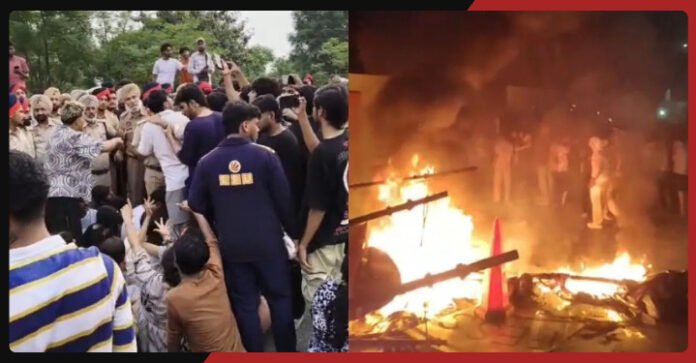

A major student protest erupted at Lovely Professional University (LPU) in Phagwara, Punjab, during the early hours of September 27 after social media reports circulated alleging that a female student had been sexually assaulted on the university campus. The reports spread rapidly among students and triggered anger, confusion and demonstrations near the girls’ hostel. Police later said the allegation was initially unverified, while subsequent reports said an investigation had been opened after police received a student’s statement.
According to reports, the unrest began at around 2 a.m. as students gathered on the university campus after messages concerning the alleged incident circulated through social media and student groups. The claims included allegations involving an outsider or construction worker and, in some versions of the message, suggestions that the student had subsequently died by suicide. Authorities have not established those claims as facts.
The situation quickly escalated. Videos circulating from the campus showed students damaging university property, including window panes and flower pots. Reports also said that objects were set on fire and that parts of buildings were affected during the disturbance. What began as a gathering over an alarming allegation therefore developed into a broader confrontation involving property damage and disruption.
The protest later moved beyond the university’s boundaries. Students reached the highway outside the campus and blocked traffic, affecting movement on the Jalandhar-Phagwara and Chandigarh-Amritsar routes. The blockade caused congestion and drew additional police personnel to the area.
Kapurthala police officials arrived at the university after receiving information about the gathering. Senior Superintendent of Police Gaurav Toora said police initially found that the protest had been triggered by rumours circulating on social media. He also said authorities were speaking with students and attempting to address their concerns.
The police response focused on restoring order while determining what had actually happened. Officials indicated that the property damage would be assessed and that legal action would follow where violations of law were established. Heavy police deployment was reported around the campus as authorities attempted to prevent further violence.
The university administration also appealed to students to remain calm and avoid participating in disruptive activities. It described the social-media claims as false and misleading and urged students to stay inside their hostels or residences rather than joining unrest.
The episode highlights how quickly unverified information can create a crisis in a densely populated university environment. A claim concerning the safety of a student can generate fear and anger before authorities have an opportunity to establish basic facts. In this case, the circulation of messages appears to have played a major role in bringing large numbers of students together during the night.
At the same time, students reportedly expressed broader concerns about university administration and campus safety. Police officials said they spoke with students who raised issues concerning the administration and that efforts were being made to understand and address those grievances.
The central question now is what actually happened to the student whose alleged assault became the subject of widespread discussion. Police investigations are expected to examine statements, CCTV recordings, forensic evidence and digital communications. Later reporting said police had received a student’s statement and registered a case, with officials indicating that technical evidence would be examined.
Until that investigation is completed, the original social-media claims should not be treated as confirmed facts. The distinction is particularly important in cases involving alleged sexual violence, where inaccurate information can harm both the investigation and people connected to the incident.
The LPU episode also demonstrates the risks associated with rumours spreading through closed messaging groups and social-media platforms. Students may receive information from friends or online accounts without knowing its original source, while emotionally charged claims can be forwarded rapidly.
For the university, restoring confidence among students is likely to require clear communication about the investigation, campus safety arrangements and any verified findings. For students, authorities have urged restraint while the facts are established.
As the investigation proceeds, police and university authorities face the dual task of determining whether a criminal incident occurred and maintaining safety across the campus. The highway blockade and property damage have added a separate legal dimension to the episode.
The immediate unrest may have subsided with the deployment of police, but the questions surrounding the alleged incident and student concerns remain. Authorities are expected to use available evidence rather than social-media speculation to determine the facts.