

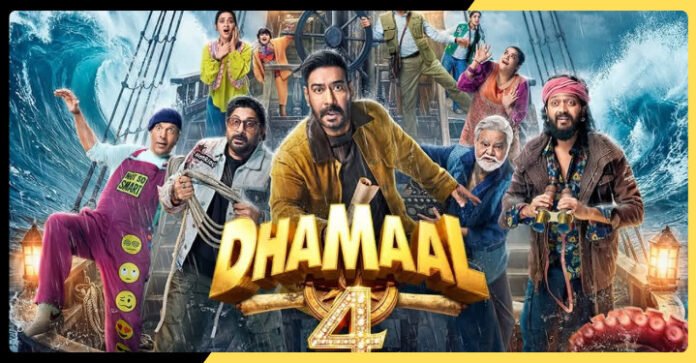

Indra Kumar’s Dhamaal 4 returns to a franchise that has always thrived on speed, greed, and idiocy. The fourth entry keeps the design intact—treasure hunts, ensemble confusion, and physical comedy—while adding fresh energy through Ajay Devgn, Arshad Warsi, and Riteish Deshmukh. The film is built for crowd-pleasing chaos, and it delivers exactly that.
Introduction: A Franchise Built on Bedlam
Since its debut in 2007, the Dhamaal series has carved out a unique space in Hindi cinema by embracing chaos as its central comic principle. Where other comedies leaned on witty dialogue or situational satire, Dhamaal thrived on greed, idiocy, and constant motion. Director Indra Kumar understood that audiences loved watching ordinary men unravel in pursuit of extraordinary treasure, and he built a franchise around that spectacle.
The first film was fresh, anarchic, and unapologetically silly. Its success spawned sequels—Double Dhamaal (2011) and Total Dhamaal (2019)—each expanding scale but never abandoning the core identity. By the time Dhamaal 4 arrived in 2026, the franchise had become both nostalgic and familiar. Audiences knew what to expect: treasure hunts, ensemble confusion, and farce built on selfishness. What makes this fourth entry significant is its conscious decision to return to basics while subtly refreshing the ensemble with Ajay Devgn alongside franchise regulars Arshad Warsi, Riteish Deshmukh, and Jaaved Jaaferi.
Greed as Comic Engine
At the heart of Dhamaal lies a simple truth: greed is funny. Characters chasing wealth abandon rationality, betray friends, and collapse under their own stupidity. This principle has sustained the franchise across two decades. Unlike Hera Pheri, which balanced greed with sentiment, Dhamaal refuses to dilute avarice with morality. Its characters rarely learn, rarely grow, and rarely repent. Their humiliation is the consequence, and their refusal to evolve is the comic loop.
Dhamaal 4 re‑centers greed as the narrative driver. Every character wants the prize, nobody trusts anyone else, and collective desperation fuels the comedy. Group scenes become machines of chaos, with vanity, impatience, and idiocy colliding to produce rhythm. The film succeeds whenever it allows greed to dictate action, reaffirming that avarice remains a timeless comic principle.
Plot Mechanics: Pursuit Without Pause
The film’s structure is simple yet sturdy: a treasure chase propels characters through traps, jungles, cliffs, disguises, and betrayals. The screenplay ensures constant motion, never allowing the story to stagnate. The humor lies in interruption—plans collapsing instantly under selfishness.
Weaknesses emerge in repetition. Several gags are stretched beyond their natural finish, mistaking loudness for escalation. Instead of sharpening the second beat of a joke, the film sometimes simply raises its decibel level. Yet the propulsion keeps the narrative watchable, ensuring that comedy never collapses entirely under its own weight.
Performances: Anchors and Agents of Chaos
Ajay Devgn anchors the madness with composed restraint, functioning as the stabilizer amid chaos. His calm presence contrasts the frenzy, giving balance to scenes. Arshad Warsi remains the sharpest comic tool, his timing precise, his irritation cutting through noise with intelligence. Riteish Deshmukh supplies elastic energy, leaning into physical exaggeration with full commitment. The contrast between Warsi’s precision and Deshmukh’s looseness creates rhythm, while Jaaved Jaaferi embodies the franchise’s spirit with cartoonish unpredictability.
Supporting players add texture. Sanjay Mishra makes pauses funny, his vocal inflections adding absurdity. Ravi Kishan registers strongly, his sharp presence fitting the oversized comic design. Female leads—Esha Gupta, Anjali Anand, Sanjeeda Shaikh—are underwritten, serving more as plot devices than memorable comic presences. Still, the ensemble’s conviction sustains the film, with principal performers carrying the comic burden with assurance.
Direction and Craft: Familiarity as Strength
Indra Kumar directs with complete faith in franchise familiarity. He orchestrates confusion without losing coherence, staging crowd scenes with command and keeping multiple performers active within the same comic space. His direction falters when excess replaces invention, but his confidence in the formula ensures that Dhamaal 4 never loses its sense of purpose.
Technically, the film is functional rather than elegant. Sudhir K. Chaudhary’s cinematography prioritizes clarity over flourish, protecting comic timing but limiting visual personality. Sanjay Sankla’s editing maintains pace, though some set pieces overstay their welcome. Amar Mohile’s score supports action efficiently but lacks distinctiveness.
Thematic Simplicity: Adults in Comic Collapse
Thematically, Dhamaal 4 remains committed to greed as a comic principle. Characters are not psychologically deep, nor do they need to be. Their avarice is the joke, their humiliation the consequence, and their refusal to learn the franchise’s central comic loop. That simplicity gives the film consistency. It understands that the spectacle of adults surrendering dignity for fantasy is enough to sustain farce.
Franchise Evolution: From 2007 to 2026
Tracing the arc:
Dhamaal (2007): Fresh chaos, treasure-hunt novelty.
Double Dhamaal (2011): Amplified but repetitive.
Total Dhamaal (2019): Expanded scale, diluted spontaneity.
Dhamaal 4 (2026): Return to basics, ensemble-driven chaos.
The series has survived because it refuses subtlety. It thrives on confusion, pursuit, and shameless excess.
Audience Reception and Box Office
Critics praised ensemble chemistry and narrative propulsion while noting repetition and functional visuals. Audiences embraced the chaos, proving that franchise familiarity drives turnout. Social media amplified the film’s gags, memes celebrating its loudness and excess.
Critics Rating: ★★★★☆ (4/5)
Box Office Rating: ★★★½☆ (3.5/5)
Conclusion: A Solid Return to Chaos
Dhamaal 4 is loud, crowded, and shamelessly excessive—but that is precisely its identity. It succeeds through ensemble chemistry, narrative propulsion, and clarity of purpose. The writing lacks precision, several jokes are overextended, and the visual treatment remains functional when it should have been more vivid. Yet none of this derails the film. For viewers who come to this franchise for confusion, pursuit, and farce, Dhamaal 4 delivers a confident revival that understands exactly what must be preserved and what can be amplified.