

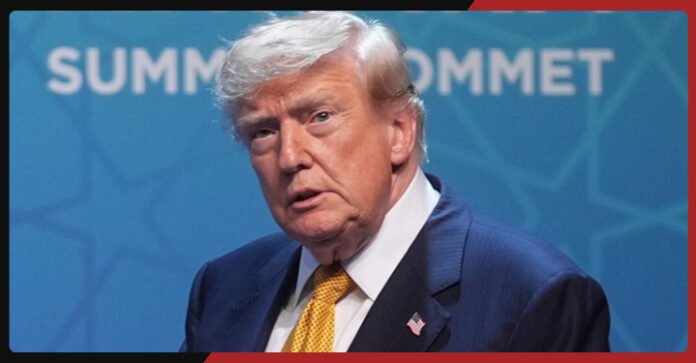

The dramatic decision to secretly move US President Donald Trump onto a different aircraft during his departure from Turkey has taken a new turn after reports emerged that some US intelligence officials had serious doubts about the Israeli intelligence behind the threat assessment.
Trump was attending a NATO summit in Ankara on July 8 when security officials decided that his departure required an extraordinary level of secrecy. Instead of simply leaving Turkey aboard the aircraft he had publicly boarded, Trump was reportedly transferred covertly to a smaller US military aircraft. A catering vehicle was used as cover during the operation, while the aircraft Trump had appeared to board remained part of the deception.
The latest reporting suggests that the intelligence warning came from Israel and involved an alleged Iranian plot against Trump. According to reports, Israeli officials passed information to the CIA indicating that Iran or an Iran-linked group could pose a threat to the president. However, American intelligence analysts reportedly assessed the information with low confidence. In other words, they did not consider the intelligence sufficiently convincing to establish that an imminent assassination attempt was definitely being planned.
That distinction is important because intelligence agencies routinely classify information according to levels of confidence. A low-confidence assessment does not necessarily mean the information is false. Rather, it means analysts believe the available evidence is not strong enough to support a firm conclusion.
In this case, the uncertainty appears to have existed alongside a separate security concern: whether the newer aircraft Trump had arrived on was adequately equipped for a potentially hostile environment.
The aircraft, a Boeing 747-8 donated by Qatar and rapidly modified for presidential use, had attracted scrutiny because it had not been purpose-built from the beginning as a presidential aircraft. The older Air Force One aircraft, by contrast, was designed around presidential security requirements and has specialized defensive systems.
Reports have indicated that the threat information included concerns about a possible missile attack. One account said American officials were told that an individual near the NATO summit may have been seen with a shoulder-fired missile. Such weapons can pose a serious threat to aircraft operating at relatively low altitude, although the precise credibility and circumstances surrounding that information remain disputed.
Despite intelligence doubts, the Secret Service apparently chose not to gamble with the president’s safety.
Trump was therefore secretly transferred to a C-32A aircraft, which flew him from Ankara toward Britain. The unusual operation reportedly involved only a small group of aides, while other officials and journalists remained aboard the decoy aircraft. The aircraft carrying Trump was also reportedly escorted by fighter jets during part of the journey.
The episode highlights a fundamental difference between intelligence analysis and presidential security. Intelligence officials may conclude that information is uncertain, but the Secret Service operates under a different standard. When the potential consequence is the assassination of a president, even a threat judged unlikely can trigger precautionary measures.
The controversy now centers on how much weight should have been given to the Israeli warning. Some US officials reportedly believed that the intelligence could have been intended not only to warn Washington but also to influence US policy toward Iran and the wider Middle East.
Israel has strong intelligence capabilities concerning Iran, and Washington regularly receives intelligence from allied governments. But intelligence sharing does not automatically mean that every warning is accepted as accurate. Analysts must compare foreign intelligence with information collected independently by US agencies.
That appears to have happened in this case, with some American officials reportedly questioning whether the Israeli information could be independently verified.
Nevertheless, the Secret Service had another consideration: the potential consequences of being wrong.
If the threat had been genuine and the president had remained aboard a less-protected aircraft, the consequences could have been catastrophic. Moving Trump to another aircraft therefore provided an additional layer of protection without requiring officials to publicly acknowledge the precise intelligence they had received.
The operation also demonstrated how presidential security can involve deception. By allowing the public to believe Trump had departed on the older Air Force One, security officials could make it harder for anyone monitoring his movements to determine his actual location.
The episode has raised questions about the reliability of intelligence, the security of the new presidential aircraft and the relationship between American and Israeli intelligence agencies.
For now, there is no public evidence establishing that Iran actually possessed a confirmed operational plan to attack Trump’s aircraft. What is known is that a warning was passed from Israel to the United States, some US analysts reportedly regarded it as low confidence, and the Secret Service ultimately decided that the safest course was to act anyway.
The incident is therefore less a simple story of a proven assassination plot than a case study in how governments respond when intelligence is uncertain but the potential consequences are extraordinarily high.