

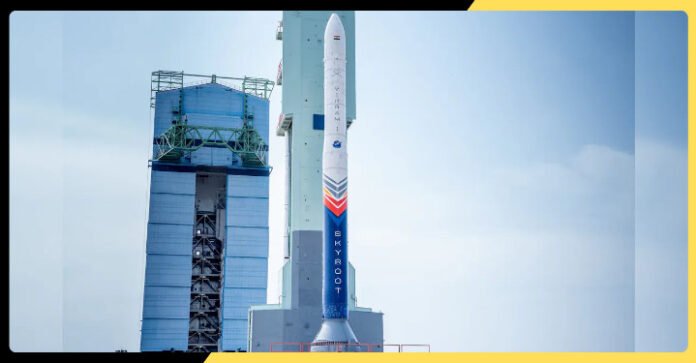

Skyroot Aerospace has achieved a landmark moment for India’s private space industry with the successful orbital mission of Vikram-1. The achievement marks a significant technological milestone, reinforcing the company’s position as one of the country’s most promising space startups. However, while reaching orbit represents a major engineering triumph, it also signals the beginning of a far more challenging journey—building a profitable and sustainable commercial space business.
The global launch industry has become increasingly competitive over the past decade. Private companies are no longer judged solely by their ability to build rockets but by their capacity to attract customers, secure recurring contracts, and operate at competitive costs. For Skyroot, Vikram-1’s success provides credibility, but long-term success will depend on converting technical achievements into steady business growth.
Skyroot was founded with the ambition of making satellite launches faster, more affordable, and more accessible. The company has focused on developing lightweight launch vehicles using advanced materials, additive manufacturing, and modular rocket technologies. These innovations aim to reduce production costs while allowing greater flexibility in meeting customer requirements. Vikram-1 represents years of research, testing, and engineering, showcasing the company’s ability to compete in an industry traditionally dominated by government agencies.
The timing of Skyroot’s achievement is significant. The global small satellite market is expanding rapidly as governments, universities, defense organizations, and private companies increasingly rely on satellites for communication, Earth observation, navigation, climate monitoring, and scientific research. Hundreds of satellites are expected to be launched annually over the coming years, creating demand for dedicated launch services capable of placing payloads into precise orbits.
This growing market presents substantial opportunities for Skyroot. Unlike larger rockets that often carry multiple satellites for different customers, dedicated small launch vehicles offer greater scheduling flexibility and customized orbital placement. Such services are attractive to satellite operators seeking faster deployment without waiting for rideshare opportunities.
Despite these opportunities, the commercial launch business remains financially demanding. Developing rockets requires continuous investment in research, testing, manufacturing facilities, quality assurance, and skilled personnel. Even after a successful mission, companies must invest heavily in improving reliability, increasing launch frequency, and reducing operational costs. A single successful launch is rarely enough to guarantee long-term profitability.
Customer confidence is another critical factor. Satellite operators place extremely valuable payloads aboard launch vehicles, making reliability one of the industry’s most important selling points. Potential clients often prefer companies with multiple successful launches before committing major commercial contracts. Skyroot will therefore need to establish a consistent track record of successful missions to strengthen its reputation in international markets.
Competition is equally intense. Global launch providers are continually introducing reusable rockets, cost-saving technologies, and integrated launch services. Established players already possess extensive customer networks, production capacity, and operational experience. To compete effectively, Skyroot must differentiate itself through competitive pricing, flexible launch schedules, rapid mission preparation, and dependable performance.
Government support continues to play an important role in India’s emerging private space ecosystem. Regulatory reforms have opened new opportunities for private participation, while collaboration with national space institutions provides valuable infrastructure and technical expertise. These policy changes have encouraged investors to support space startups, recognizing the sector’s long-term economic potential.
Investor expectations, however, are also increasing. Venture capital firms and strategic investors seek evidence that startups can move beyond technological demonstrations toward generating sustainable revenue. Future funding rounds will likely depend on Skyroot’s ability to secure commercial launch contracts, expand its customer base, and demonstrate operational efficiency.
Looking ahead, Skyroot’s success will depend on much more than rocket technology. Building a resilient supply chain, maintaining high manufacturing standards, expanding launch capacity, and developing strong international partnerships will all be essential. The company may also explore complementary services such as satellite deployment solutions, mission planning, and space logistics to diversify revenue streams.
Vikram-1’s successful journey to orbit represents a defining moment for India’s private space ambitions. It proves that Indian startups possess the engineering talent and innovation needed to compete globally. Yet history shows that technological breakthroughs alone do not create enduring businesses. Skyroot’s next challenge is transforming this historic achievement into a reliable commercial enterprise that can consistently deliver value to customers, investors, and the broader space industry. If it succeeds, the company could become a cornerstone of India’s rapidly growing space economy and inspire a new generation of private aerospace innovation.