

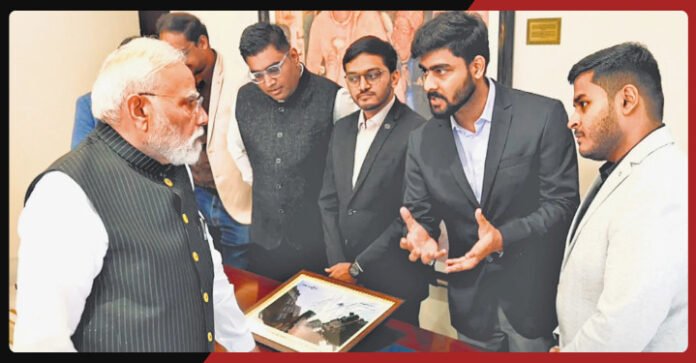

Prime Minister Narendra Modi has said India has the potential to establish itself rapidly in the global space sector, highlighting the country’s cost competitiveness, skilled workforce and growing appetite for technological risk-taking. His remarks came during an interaction with CEOs and founders of 20 Indian space startups ahead of National Space Day.
Modi said India should not limit its ambitions to building successful domestic space companies. Instead, the country should create an ecosystem so attractive that people from around the world consider India a preferred destination for building careers and businesses in space technology. According to the Prime Minister, India needs to develop an “aura” around its space sector that encourages international talent, companies and investors to look towards the country.
The Prime Minister’s comments come at a time when India’s private space ecosystem is expanding rapidly. Government reforms have opened greater opportunities for private companies to participate in activities that were traditionally dominated by state institutions. According to government data presented in Parliament in July, private investment in India’s space sector had crossed $618 million, while 105 authorisations had been issued to private entities.
The government has also said India’s space startup ecosystem has grown to more than 400 companies following reforms designed to encourage private participation and innovation.
During the interaction, Modi pointed to the combination of affordability and technical talent as one of India’s biggest advantages. Space missions require substantial investment, advanced engineering and years of research. India’s ability to develop technologies at comparatively competitive costs could therefore become an important factor in attracting international business.
Another major issue highlighted by the Prime Minister was policy stability. Entrepreneurs entering the space sector have to make long-term investments and accept considerable technological and financial risks. Modi said consistent government decisions can provide companies with confidence to take those risks.
The interaction involved startups working across a broad range of technologies, including rockets, satellites, propulsion systems, avionics, space intelligence, debris removal and AI-powered weather and climate intelligence. Companies such as Skyroot Aerospace, Agnikul Cosmos, Pixxel, Dhruva Space, GalaxEye, Digantara and others participated in the meeting.
Modi also encouraged startups to expand the use of space technology beyond traditional applications. He suggested greater collaboration between space companies and sectors such as agriculture, environment and other areas directly connected with people’s lives.
This approach reflects a broader vision in which space technology is not viewed only as a tool for exploration or satellite launches. Satellite-based systems can contribute to agriculture, weather forecasting, environmental monitoring, communications and disaster management.
The Prime Minister also called for stronger engagement with educational initiatives such as Atal Tinkering Labs. The objective is to encourage curiosity among young students and help develop the next generation of scientists, engineers and entrepreneurs.
India’s space journey has historically been led by ISRO, but the growing private ecosystem is changing the structure of the industry. The government now wants Indian startups to become global companies capable of competing internationally.
Modi’s message was therefore not simply about increasing the number of launches or satellites. It was about creating a complete ecosystem where innovation, investment, talent and entrepreneurship reinforce each other.
If India can successfully combine its technical workforce, competitive costs, policy support and expanding startup culture, the country could strengthen its position in the global space economy. The Prime Minister’s remarks indicate that New Delhi now sees private space companies as important partners in achieving that ambition.