

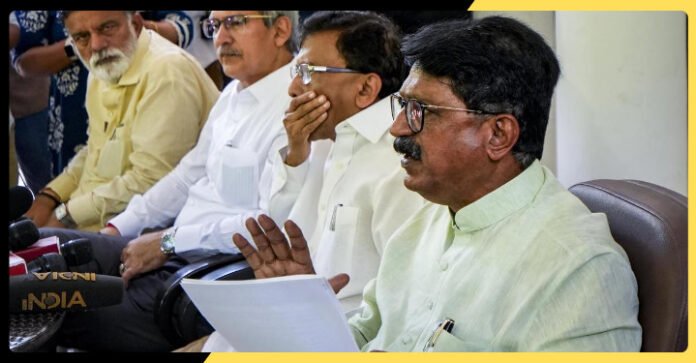

The political controversy surrounding the alleged “Operation Tiger” has intensified after the Shiv Sena (UBT) claimed that its Members of Parliament were offered ₹50 crores each to switch allegiance. The party has framed the alleged incident as part of a broader attempt to destabilize opposition unity, while also raising concerns over the current whereabouts and contactability of some of its MPs.
According to the party’s allegations, unidentified political intermediaries approached certain MPs with a lucrative offer aimed at inducing them to defect. The supposed offer of ₹50 crores per MP has triggered a sharp political backlash, with Shiv Sena (UBT) leaders describing it as an orchestrated attempt to “hunt and capture” elected representatives—hence the internal label “Operation Tiger.” The party has not yet provided independently verified evidence in the public domain, but insists that internal communication records and testimonies exist to substantiate the claim.
The controversy has also taken a new turn with Shiv Sena (UBT) leaders expressing uncertainty over the current whereabouts of some of their MPs. Party functionaries have suggested that they have been unable to establish regular communication with a few elected representatives, fueling speculation and anxiety within the organization. However, no official list of missing or unreachable MPs has been released, and there has been no independent confirmation of any enforced disappearance or coercion.
Opposition leaders within the party argue that such incidents reflect a continuing pattern of political pressure tactics aimed at weakening rival parties. They claim that financial inducements, coupled with strategic isolation of elected representatives, are being used to engineer political realignments outside the electoral mandate. These allegations, however, remain politically contested and have been firmly denied by rival camps, who have dismissed them as baseless and politically motivated narratives intended to generate sympathy and media attention.
The situation has also reignited broader debates about party loyalty, anti-defection safeguards, and the role of money in electoral politics. India’s anti-defection law was designed to prevent elected representatives from switching parties in exchange for incentives or personal gain, but critics argue that enforcement mechanisms remain weak and often reactive rather than preventive. The “Operation Tiger” allegations have therefore become a fresh reference point in discussions about whether existing legal frameworks are sufficient to deter political horse-trading.
Meanwhile, within Shiv Sena (UBT), internal coordination meetings are reportedly being held to assess the situation and ensure communication with all elected representatives. Senior leaders have urged MPs to remain in close contact with the party leadership and avoid external engagements that could be misinterpreted. The leadership has also emphasized unity and discipline, warning against misinformation and external pressure.
Political observers note that such allegations, whether proven or not, tend to escalate quickly in India’s highly competitive coalition politics environment. Even unverified claims can shape public perception, influence voter sentiment, and alter alliance dynamics. Analysts also point out that accusations of large-scale monetary inducement are not new in Indian politics, though they are rarely substantiated with conclusive evidence in real time.
As the controversy continues to unfold, both political camps are expected to escalate their messaging strategies. While Shiv Sena (UBT) seeks to highlight the alleged attempt as a threat to democratic integrity, rival parties are likely to counter with demands for proof and accusations of political theatrics.
For now, “Operation Tiger” remains a politically charged claim at the center of a growing dispute—one that underscores the volatility of party alignments and the persistent suspicion that surrounds high-stakes legislative politics in India. Whether the allegations lead to formal investigations or fade into the larger cycle of political rhetoric will depend on the emergence of verifiable evidence and the responses of investigative authorities in the coming days.