

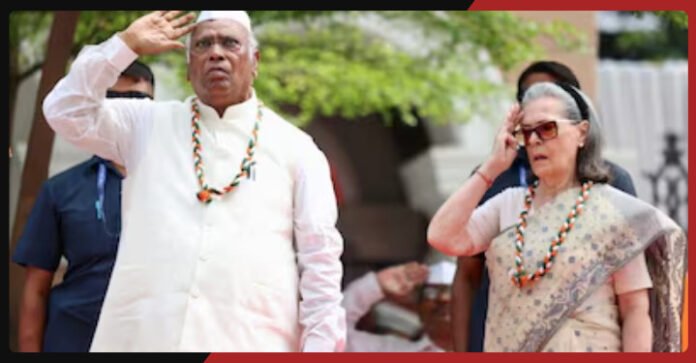

A political controversy erupted on Independence Day 2026 after a video from the Congress headquarters in New Delhi appeared to show senior Congress leader Sonia Gandhi making gestures during the rendition of “Vande Mataram.” The footage quickly became the centre of a political dispute, with BJP leaders alleging that Gandhi and Congress president Mallikarjun Kharge were attempting to stop or interrupt the full rendition of the national song. Congress, however, strongly rejected the allegation and offered a different explanation for what the gestures meant.
The controversy comes at a particularly sensitive moment because 2026 marks the 150th anniversary of “Vande Mataram.” The national song has occupied an important place in India’s freedom movement and has long been associated with patriotic gatherings. This year, its significance was further highlighted by the decision to include it prominently in the Independence Day programme at the Red Fort. For the first time, “Vande Mataram” was scheduled to be sung from the ramparts before the national anthem.
Against this background, the video from the Congress event attracted considerable attention. BJP leaders claimed that Sonia Gandhi’s gestures indicated an objection to the complete rendition of “Vande Mataram.” The accusation was amplified through social media, where short clips circulated without the full context of the event. Critics interpreted the gestures as an attempt to bring the performance to an end.
Congress leaders disputed that interpretation. The party said there was no attempt to insult, interrupt or stop “Vande Mataram.” According to the explanation reported by several media outlets, Gandhi was trying to arrange a chair for Mallikarjun Kharge rather than asking the song to be stopped. Congress MP Jairam Ramesh also rejected the controversy and said that the complete version of the song had been sung at the party headquarters.
The disagreement therefore revolves largely around the interpretation of a short video. The footage shows Sonia Gandhi and Kharge making gestures while the rendition is underway, and some viewers interpreted those movements as signals to stop the song. But a gesture visible in a video does not automatically establish what the person intended. Context, timing and the explanation offered by those involved all matter when assessing such a claim.
The political temperature surrounding “Vande Mataram” has also increased because the song has received greater official attention in 2026. The government has promoted the complete version of the song as part of the celebrations marking its 150th anniversary. Reports have also highlighted new protocols concerning its performance at official functions.
That makes the Sonia Gandhi controversy politically significant beyond the individual video. The BJP has used the episode to question the Congress leadership’s attitude towards national symbols, while Congress has accused its political opponents of creating a controversy around a misleading interpretation of the footage.
For the BJP, the issue is straightforward: if a senior political leader appears to object while a national song is being performed, the matter deserves public scrutiny. BJP leaders have demanded explanations and, in some cases, an apology from Congress.
For Congress, the matter is equally clear but from the opposite perspective. The party argues that the video is being presented selectively and that the gestures have been wrongly interpreted. Its position is that the full song was performed and that Sonia Gandhi’s actions had nothing to do with disrespecting “Vande Mataram.”
The controversy also demonstrates how quickly political disputes can grow around short social-media videos. A few seconds of footage can generate competing narratives before the complete circumstances are understood. In highly polarised political environments, such clips can become symbols of much larger ideological battles.
It is important, therefore, to distinguish between an allegation and an established fact. The allegation that Sonia Gandhi “insulted” or tried to stop “Vande Mataram” has been made by political opponents. Congress has categorically denied it. Available reports confirm that the video exists and that gestures were made, but the meaning of those gestures remains disputed.
The episode is likely to remain part of the political debate because “Vande Mataram” carries enormous historical and emotional importance. The song played a major role during the freedom struggle and was later recognised as India’s national song. It was given a status equal in honour to the national anthem by the Constituent Assembly’s decision in January 1950.
Ultimately, whether the controversy fades or becomes a larger political issue will depend on how both parties continue to frame it. Congress is likely to maintain that there was no disrespect, while the BJP can be expected to keep questioning the visual evidence. What is clear is that the incident has turned a routine Independence Day celebration at the Congress headquarters into another political flashpoint.
The central question remains simple: did Sonia Gandhi actually object to “Vande Mataram,” or were her gestures related to something else happening at the venue? Based on the explanations currently available, Congress says the latter. The accusation remains political, while the interpretation of the video continues to fuel the dispute.