

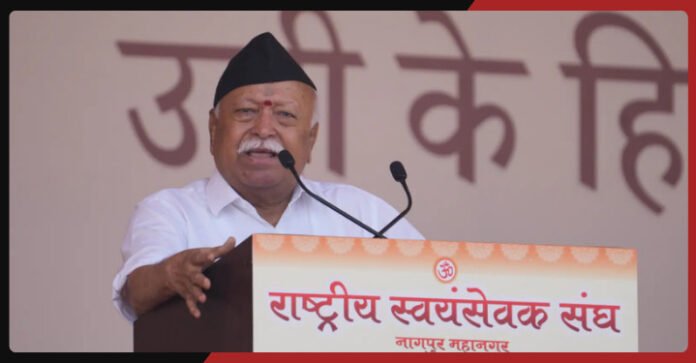

Rashtriya Swayamsevak Sangh (RSS) chief Mohan Bhagwat has warned against attempts to bring about what he described as “regime change” in India, referring to political unrest and developments in countries including France, Albania, Bangladesh and Nepal. Speaking at the organisation’s annual Vijayadashami celebrations in Nagpur on October 20, Bhagwat argued that changing a government does not automatically resolve the underlying problems facing a society. His remarks come amid an ongoing political controversy over protests related to the Election Commission and demands for accountability in electoral processes.
Bhagwat’s address focused on national unity, political stability and the importance of ensuring that public movements remain directed towards finding solutions. He suggested that demonstrations could lose their constructive purpose if they became vehicles for personal ambitions, political rivalries or attempts to create hostility between different sections of society.
The RSS chief referred to unrest in several countries to illustrate his concerns. His argument was that political upheavals, leadership changes and public demonstrations do not necessarily deliver the improvements that protesters expect. He maintained that India should not assume that replacing a political establishment would, by itself, address economic, social or institutional challenges.
His comments also reflected the wider debate over the role of public protests in a democracy. Demonstrations are a recognised means through which citizens express dissatisfaction, demand accountability and bring attention to problems that may otherwise receive limited attention. At the same time, questions about public order, political messaging and the consequences of prolonged unrest often become central to debates surrounding major demonstrations.
Bhagwat urged people to ensure that movements remained focused on resolving grievances rather than encouraging hostility. He emphasised the need to respect constitutional principles and maintain appropriate standards of public conduct. His message placed social cohesion and national development at the centre of his argument.
The remarks also included a broader concern about international influences. Bhagwat alleged that external forces could exploit domestic disagreements to weaken countries and advance their own interests. These assertions represent his assessment of international political developments; establishing whether particular foreign actors have influenced events in India would require separate evidence.
The political context is significant because the controversy surrounding the Election Commission has already generated competing interpretations. Critics of electoral processes argue that institutional accountability and transparent procedures are essential to public confidence. Supporters of the government and those echoing Bhagwat’s concerns have warned that some political campaigns may extend beyond their stated objectives.
These positions raise a fundamental question: how should a democracy distinguish between legitimate demands for institutional reform and political efforts intended to destabilise an elected government? The answer depends on the evidence, the methods used by protesters and the constitutional processes available for resolving disputes.
Bhagwat expressed confidence that India would not experience the kind of regime change he associated with unrest abroad. He attributed the country’s resilience to its development, leadership and the growing sense of national responsibility among its people.
However, the strength of democratic institutions also depends on public participation, independent scrutiny and the ability to question those in power. Political stability and accountability are not necessarily opposing objectives; they can reinforce each other when disputes are handled through transparent and lawful processes.
Ultimately, Bhagwat’s speech has added another dimension to the national debate over protests, governance and political change. His central message was that movements should deliver practical solutions rather than deepen social divisions. Whether political leaders, protest organisers and institutions can meet that standard will remain an important test of India’s democratic life.