

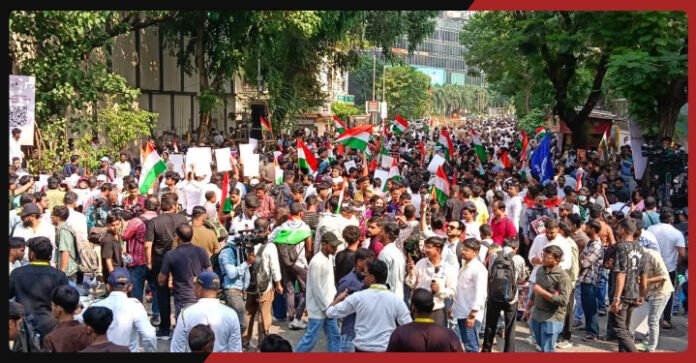

Abhijeet Dipke, founder of the Cockroach Janta Party (CJP), has intensified his campaign against Chief Election Commissioner Gyanesh Kumar, warning that the political confrontation could move beyond the Election Commission if Kumar does not resign.
Speaking at a protest at Mumbai’s Shivaji Park on October 2, Dipke demanded Kumar’s resignation and said his organisation would continue its campaign over concerns surrounding electoral-roll revisions. According to Hindustan Times, Dipke also warned of a “Jantar Mantar 2.0” campaign and said that if the demand concerning Kumar was not met, the protest movement would subsequently raise a demand involving Prime Minister Narendra Modi.
The remarks come amid a wider political dispute over the functioning of the Election Commission and the Special Intensive Revision (SIR) of electoral rolls. Critics of the process have raised concerns about the deletion and verification of voter names, while the Election Commission has maintained that its actions are part of the electoral-roll revision process and has rejected allegations of wrongdoing.
Dipke’s campaign has made Kumar the central figure in its latest political mobilisation. The CJP has accused the Election Commission of failing to adequately protect the integrity of electoral rolls. Those accusations have been strongly contested, and claims concerning the scale and nature of voter deletions remain a subject of political and public debate.
The controversy has also been linked to reported disagreements within the Election Commission. Earlier reporting by The Indian Express said that Election Commissioners Sukhbir Singh Sandhu and Vivek Joshi had raised objections on multiple occasions concerning decisions related to the SIR process. The report has added to questions surrounding the commission’s internal decision-making, although disagreements within an institution do not by themselves establish wrongdoing.
Dipke’s latest warning represents an escalation in the CJP’s campaign. The organisation has said that its protests will continue until its demand concerning Kumar is addressed. Reports indicate that the group has also announced plans for another demonstration in Delhi.
The movement is using the slogan-driven style that has characterised CJP demonstrations, while attempting to broaden its campaign around electoral transparency. During the Mumbai protest, supporters reportedly raised slogans targeting Kumar, while several public figures also attended or expressed support for concerns about electoral accountability.
The dispute is now moving into a broader political space because Dipke has linked the future of the protest to the central government and the prime minister. His statement should therefore be understood as a political demand made by the CJP rather than as an established finding about the prime minister or the Election Commission.
For the Election Commission, the controversy comes at a sensitive time as voter-roll revision remains a major issue in several parts of the country. The commission faces pressure from political parties, civil-society groups and campaigners who want greater transparency over how electoral rolls are prepared and corrected.
As the CJP prepares for further demonstrations, the focus is likely to remain on three questions: whether Gyanesh Kumar will respond to the resignation demand, how the Election Commission explains the SIR process, and whether the dispute expands into a larger confrontation involving the Union government.
For now, Dipke’s message is clear: the campaign that began with a demand concerning the Chief Election Commissioner is being framed by the CJP as part of a wider debate about electoral accountability and political responsibility.