

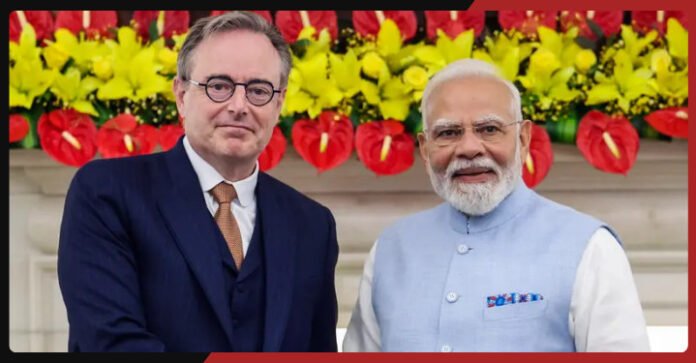

Belgian Prime Minister Bart De Wever has made a significant statement highlighting India’s growing importance in the changing global economic and geopolitical order. During his visit to India, De Wever acknowledged that Europe had failed to recognise the dangers of excessive economic dependence early enough and admitted that Prime Minister Narendra Modi had warned European countries about these risks long ago.
Speaking about Europe’s changing approach towards global trade and strategic partnerships, the Belgian leader said that India had understood the dangers of dependency earlier than Europe. According to him, European countries are now experiencing what he described as a delayed awakening.
The remarks have attracted attention because they come at a time when countries around the world are reconsidering their supply chains, trade partnerships and economic dependencies. Global politics has changed dramatically in recent years, with major powers increasingly using trade, technology and economic relationships as instruments of strategic influence.
De Wever said Europe had allowed certain economic dependencies to grow over the years, creating vulnerabilities that could eventually be used as leverage. He pointed to the challenge created when industries become dependent on external suppliers for critical goods, technology, raw materials and manufacturing.
The Belgian Prime Minister credited India with recognising these dangers earlier. He said Prime Minister Modi had warned Europe about such strategic vulnerabilities, but Europe did not fully listen at the time.
Now, however, the situation appears to be changing.
Europe is increasingly looking for reliable partners that can help create resilient supply chains and reduce excessive dependence on any single country or economic bloc. In this changing environment, India has emerged as one of the most important potential partners for Europe.
De Wever’s statement also reflects the growing strategic relationship between India and Belgium. The two countries have agreed to strengthen cooperation in areas including trade, defence, clean energy, critical minerals, semiconductors, research and investment.
India and Belgium have also discussed mechanisms aimed at encouraging greater investment and expanding economic cooperation. The broader relationship is part of the growing engagement between India and Europe.
For India, the Belgian Prime Minister’s remarks represent recognition of the country’s long-standing emphasis on strategic autonomy and diversified partnerships. India has repeatedly focused on the importance of avoiding excessive dependence while maintaining strong economic relationships with multiple countries.
The global economy is becoming increasingly competitive and uncertain. Supply-chain disruptions, geopolitical conflicts, tariffs and technological competition have forced governments to reconsider traditional approaches to trade.
Europe’s new approach appears to be shaped by these realities.
De Wever’s admission that Europe is listening now may therefore mark more than just a diplomatic compliment to India. It could signal a deeper shift in how European countries view India—as not only a large market but also as a strategic and trusted long-term partner.
The Belgian Prime Minister’s words underline a larger message: in a world where economic dependence can become a geopolitical vulnerability, partnerships based on trust, diversification and mutual respect are becoming increasingly valuable.
And according to De Wever, Europe may have realised this lesson later than India—but the awakening, he says, has finally begun.