


Prelude: A Cinematic Aberration
In an epoch where Hindi cinema’s dalliance with the superhero idiom has largely been subsumed by pyrotechnic excess and star‑driven grandiloquence, Manish Saini’s The Great Grand Superhero emerges as a curious anomaly. It eschews the bombastic architecture of franchise spectacle in favour of a more intimate dramaturgy, wherein the locus of heroism is refracted through filial bonds and the burdens of inheritance.
Narrative Exposition: Familial Gravity Cloaked in Fantasy
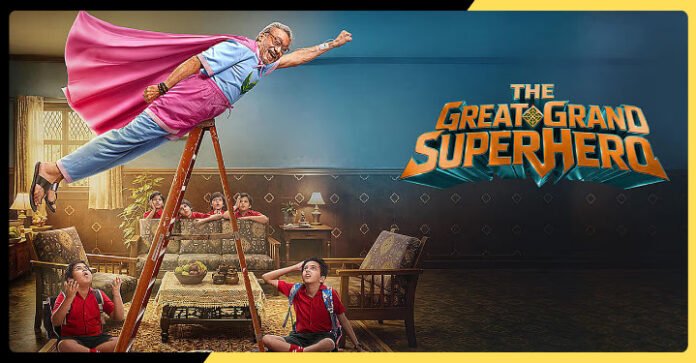
The film’s narrative scaffolding is deceptively simple: a peripatetic child, denied the quotidian rhythms of stability, discovers that his grandfather—embodied with eccentric gravitas by Jackie Shroff—harbours clandestine powers deployed against extraterrestrial incursions. Yet beneath this veneer of science‑fictional intrigue lies a meditation on displacement, secrecy, and the isolating paradox of wonder.
Saini orchestrates the tale as a domestic fable before permitting it to metastasize into alien‑invasion spectacle. The grandfather’s abilities are not valorised as divine endowments but problematised as existential encumbrances, shaping the family’s itinerant existence. The film’s most poignant cadences arise when it interrogates how the miraculous can estrange rather than console.
Performative Textures: Shroff’s Gentle Gravitas
Jackie Shroff anchors the film with a performance suffused with warmth and whimsicality. He resists the temptation to embody the superhero as an omnipotent colossus; instead, he imbues the character with gentleness, eccentricity, and a patina of lived experience. His portrayal is less a spectacle of invincibility than a study in weary resilience.
Prateik Babbar contributes a grounded sobriety, tempering the narrative’s more fantastical oscillations. Bhagyashree lends dignity and maternal softness, while Saharsh Kumar Shukla injects comic buoyancy without descending into caricature. Sharat Saxena, with his familiar authority, stabilises the ensemble. The child protagonist functions as the narrative’s epistemic lens, embodying curiosity, fear, and displacement.
Aesthetic and Craft: Modesty as Method
Saini’s directorial ethos is most persuasive when he treats the superhero genre as allegorical fable rather than industrial spectacle. Swathy Deepak’s cinematography privileges clarity and interpersonal framing over visual density. The special effects, though modest, are functional, occasionally betraying budgetary constraints. Deepa Bhatia’s editing maintains a measured cadence, though expository passages occasionally attenuate urgency.
The score, curated by Night Song Records, oscillates between cheerful accessibility and ephemeral resonance. It sustains the film’s family‑friendly tenor without lapsing into saccharine excess.
Thematic Resonance: The Burden of Inheritance
The film’s thematic marrow lies in its exploration of inherited responsibility. Heroism is not construed as triumphal conquest but as reconciliation with the sacrifices demanded by love. The grandfather’s powers matter less as instruments of combat than as catalysts of familial strain.
This inversion of genre logic—where vulnerability supersedes omnipotence—renders the film emotionally persuasive even when its science‑fictional mechanics falter.
Genealogical Context: Indian Superhero Cinema
Placed within the genealogy of Indian superhero cinema, The Great Grand Superhero occupies a distinctive niche. Mr. India (1987) allegorised invisibility as social justice; Krrish sought to erect a franchise edifice; Ra.One experimented with digital aesthetics; Bhavesh Joshi Superhero interrogated civic corruption. Saini’s film diverges by privileging sincerity over scale, intimacy over universality.
Comparative Discourse: Local Intimacy vs. Global Spectacle
Where Hollywood thrives on interconnected universes and escalating stakes, Indian cinema has faltered in sustaining such architectures. Saini circumvents this by refusing to compete. His modesty becomes radical, aligning the film more with The Incredibles than with Avengers. By rooting heroism in domestic bonds, he crafts a narrative culturally specific yet universally intelligible.
Limitations: Predictability and Modest Scope
The screenplay adheres to familiar beats—secret identity, looming peril, climactic confrontation. Supporting characters are unevenly etched, and the visual effects occasionally lack surprise. Yet these deficiencies are mitigated by sincerity. The film never lapses into cynicism; its emotional nucleus remains intact.
Verdict: Sincerity Over Spectacle
The Great Grand Superhero is affectionate, uneven, yet undeniably likable. It does not reinvent the genre, nor does it aspire to. Its commercial trajectory may be modest, but its emotional resonance is genuine. Jackie Shroff’s performance imbues the film with warmth and humour, rendering the grandfather figure authentic rather than gimmicky.
For audiences fatigued by hollow spectacle, Saini’s film offers a gentler alternative—a superhero tale with an Indian emotional core.
Ratings
Critics’ Rating: 3.5/5
Box Office Rating: 2/5
Coda: The Radical Modesty of Saini’s Vision
In an industry increasingly enthralled by gigantism, The Great Grand Superhero demonstrates that intimacy can be as compelling as scale. Its modesty is not deficiency but defiance, a reminder that cinema’s power lies not merely in spectacle but in sincerity.