

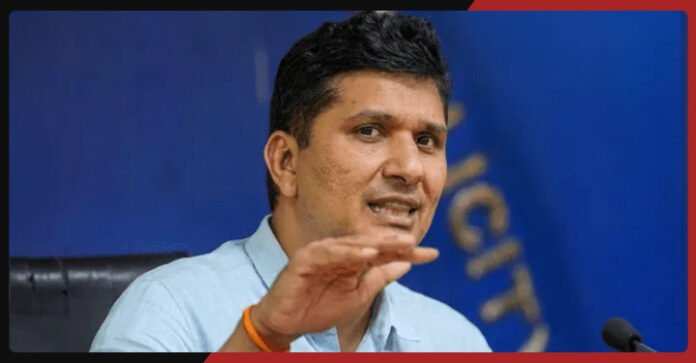

The political battle over government advertisements in Delhi escalated sharply after Aam Aadmi Party leader Saurabh Bharadwaj questioned the Bharatiya Janata Party over what he claimed was around ₹22,000 crore spent by BJP-ruled state governments on advertisements. His remarks came after Delhi Lieutenant Governor V K Saxena directed officials to recover ₹97 crore from the AAP over advertisements that were allegedly published as government publicity despite violating guidelines.
The controversy became another flashpoint between the AAP government and the office of the Lieutenant Governor. Bharadwaj argued that the issue was being applied selectively and questioned why advertisements issued by governments of other states and appearing in Delhi were not being subjected to similar scrutiny.
According to contemporary reports, Bharadwaj claimed that BJP-ruled states had placed advertisements in newspapers and other media outlets circulated outside their respective territories. He cited several states while making his calculation and put the combined expenditure at approximately ₹22,000 crore. He challenged BJP president J P Nadda to explain when such money would be returned to the exchequer.
The AAP leader’s argument was essentially a political counterattack. The immediate issue before the Delhi government was an order concerning ₹97 crore allegedly spent on advertisements that the authorities considered political in nature. Bharadwaj rejected the action and questioned the legal authority behind the recovery order.
The dispute had its roots in a broader controversy over government advertising. A Union government-appointed committee had earlier examined allegations that the Delhi government had violated Supreme Court guidelines governing government publicity. The guidelines were intended to ensure that public money used for advertisements promoted public information rather than political personalities or party interests.
The Lieutenant Governor’s office maintained that the Delhi government should recover money considered to have been improperly spent. The AAP, however, argued that advertisements about government schemes and public initiatives naturally have to reach people beyond Delhi because newspapers and television channels have audiences across state borders.
Bharadwaj also pointed to advertisements issued by governments outside Delhi and argued that the same principle should apply to them. His contention was that if advertisements published in Delhi by other state governments were accepted as legitimate public communication, the Delhi government should not be singled out simply because its advertisements appeared outside the national capital.
The controversy therefore quickly moved beyond the original ₹97-crore recovery issue. It became part of the larger political confrontation between the AAP government and the BJP, with both sides accusing the other of misusing government machinery and public resources.
The ₹22,000-crore figure, however, should be understood as Bharadwaj’s political allegation and calculation rather than as an officially established scam figure. Reports at the time attributed the claim directly to him. There is no basis in the sources reviewed to describe this amount as a proven “rice scam.”
The dispute illustrates how government advertising can become a major political issue. Publicity campaigns can be used to inform citizens about welfare programmes, health initiatives, environmental measures and public services. At the same time, critics argue that government advertising can cross the line into political promotion if it prominently highlights political leaders or parties.
For Delhi, the controversy was particularly significant because relations between the elected government and the Lieutenant Governor were already tense. The advertising dispute added another layer to disagreements over administration, investigations, public projects and the functioning of the city government.
Bharadwaj’s response sought to turn the ₹97-crore recovery demand into a wider question about consistency and accountability. His argument was that if public expenditure on advertisements was being examined, the same standards should apply across governments.
The controversy ultimately reflected a familiar feature of Indian politics: an administrative dispute quickly becoming a larger political confrontation. While the ₹22,000-crore allegation attracted attention because of its size, it remained a claim made by the AAP leader rather than a finding established by an investigation or court.
The episode also underlined the importance of distinguishing between political allegations and verified financial wrongdoing. In a matter involving thousands of crores of public money, documentary evidence, official audits and findings by competent authorities are necessary before an expenditure claim can accurately be described as a scam.