

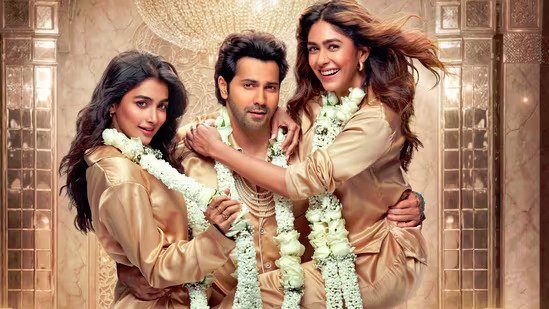

David Dhawan’s Familiar Playground
David Dhawan returns to his most recognisable cinematic territory with Hai Jawani Toh Ishq Hona Hai, a romantic comedy that thrives on exaggeration, colourful characters, and unapologetically loud comic rhythm. Produced by Ramesh Taurani and written by Yunus Sajawal with dialogues by Farhad Samji, the film does not attempt to reinvent the rom‑com genre. Instead, it embraces the familiar grammar of misunderstandings, overlapping lies, and comic set pieces that Dhawan has perfected over decades.
The story revolves around Jass (Varun Dhawan) and Baani (Mrunal Thakur), a married couple whose relationship begins to crack under clashing priorities. Their marriage is not presented as a melodramatic tragedy but as a restless battlefield where love exists alongside ego, career choices, and immaturity. When Jass walks away from the marriage, the film uses that decision as the trigger for its central comic spiral.
Preet (Pooja Hegde) enters the picture, bringing glamour and a different emotional energy. Jass must confront his feelings for Preet while grappling with the unresolved weight of his relationship with Baani. The narrative leans into revelations, public embarrassments, and family gatherings, creating a chain of comic chaos. Dhawan’s direction ensures the pacing remains brisk, with humour depending on rhythm rather than realism.
Performances – Energy, Balance and Charm
Varun Dhawan is comfortably placed in a world that suits his physical energy and comic timing. As Jass, he blends boyish charm with impatience and performative confidence. His quick reactions and exaggerated panic fit the film’s register, and he shines most when cornered by his own foolishness. While some moments feel broader than necessary, Varun’s instinct for comedy keeps the character engaging.
Mrunal Thakur provides balance as Baani. In a film that often leans toward chaos, she brings dignity and grounded presence. Her controlled performance ensures Baani is not reduced to a wronged spouse. Scenes with Varun carry the texture of a relationship marked by fatigue, history, and lingering affection.
Pooja Hegde as Preet adds glamour and brightness but also warmth and self‑belief. She could have been reduced to a narrative complication, yet her screen presence makes Preet engaging. Her chemistry with Varun has a playful quality, fitting seamlessly into the film’s high‑energy space.
The supporting cast amplifies the comedy. Maniesh Paul delivers sharp timing, Chunky Panday and Rakesh Bedi embrace broad humour, Jimmy Shergill lends weight, and Mouni Roy adds flair. Johny Lever and Rajpal Yadav invoke nostalgic comic timing, ensuring the ensemble contributes to the film’s rhythm.
Technicals – Writing, Visuals and Music
The screenplay by Yunus Sajawal follows a familiar structure, with romance, comedy, songs, and reconciliation moving in expected order. Its strength lies in density—new complications are added before earlier ones settle, giving the film restless energy. However, emotional beats sometimes feel rushed, particularly in exploring Jass and Baani’s troubled marriage.
Farhad Samji’s dialogues are built for immediate impact. Some lines land with snap and silliness, while others feel deliberately loud. Subtlety is not the ambition here; humour emerges from panic and embarrassment rather than quiet wit.
Ayananka Bose’s cinematography keeps the film visually polished and glossy. Frames favour colour, movement, and star presence, supporting the aspirational mood of a mainstream rom‑com. Ritesh Soni’s editing maintains pace, though transitions occasionally feel hurried when shifting from comedy to sentiment.
Music, composed by multiple names including Tanishk Bagchi, Javed Mohsin, Rony Ajnali, Gill Machhrai, and Akshay IP, functions as part of the film’s festive design. Songs maintain energy and visual appeal rather than deepen narrative. Raju Singh’s background score underlines confusion and romance with directness, suiting the genre.
Analysis – Dhawan’s Controlled Chaos
David Dhawan directs Hai Jawani Toh Ishq Hona Hai like a filmmaker returning to a house whose furniture he knows by touch. His command over farce is visible in crowded scenes where multiple characters enter and exit with competing motives. The film works best when it stops justifying its absurdity and simply lets the comic machinery run.
The narrative strength lies in its refusal to slow down. While the central conflict is conventional, momentum keeps the film breezy. At times, this helps accessibility; at others, emotional complexity is simplified for punchlines. Still, Jass’s journey is written as flawed rather than heroic, making the arc about consequences of carelessness rather than a simple love triangle.
The film’s thematic depth is modest but present. Beneath the madness, it explores immaturity in commitment and how love without responsibility becomes performance. Dhawan’s instinct for mainstream entertainment remains intact, turning domestic tension into theatrical confusion.
Verdict and Box Office Outlook
Hai Jawani Toh Ishq Hona Hai is an old‑school David Dhawan entertainer that knows its strengths and rarely steps outside them. Loud, colourful, occasionally messy but frequently amusing, it thrives on confusion, music, star appeal, and family‑friendly madness.
Critics have rated it 3.5/5, acknowledging its spark despite formulaic limitations. Viewers seeking sharper examinations of marriage may find it convenient, but as mainstream comedy, it delivers consistent watchability.
Box Office Prediction:
Opening Weekend (India): ₹40–50 crore (nett)
Lifetime (India): ₹120–150 crore (nett), depending on word‑of‑mouth.
Overseas Potential: Strong in UAE and UK due to Varun Dhawan’s youth connect and David Dhawan’s nostalgic brand.
The film’s biggest achievement is reviving a style of Hindi comedy without making it feel frozen in the past. Performances and pace keep the experience afloat, proving Dhawan’s brand of controlled chaos still has popular appeal when handled with conviction.