

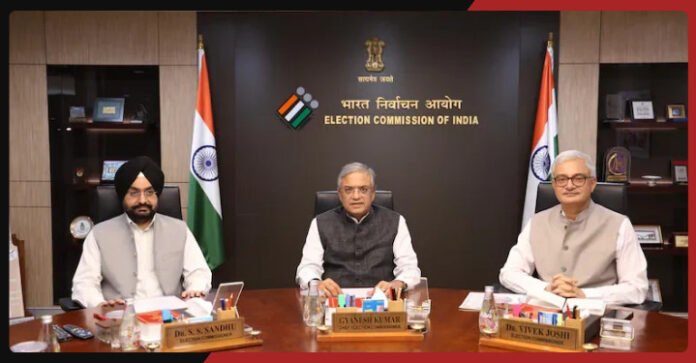

The Election Commission of India has come under renewed public scrutiny following reports of differences among its three members over the functioning of the poll panel and the Special Intensive Revision (SIR) of electoral rolls. Chief Election Commissioner Gyanesh Kumar is at the centre of the controversy, alongside Election Commissioners Sukhbir Singh Sandhu and Vivek Joshi.
The controversy intensified after a report said Sandhu and Joshi had formally recorded objections on several occasions during the past 10 months. According to The Indian Express, the objections concerned matters including electoral-roll management, voter registration, deletion and restoration of names, changes involving Form 6 and the management of the Commission’s digital systems.
The reports created questions about whether the three-member constitutional body had been functioning with complete agreement on important electoral matters. The Election Commission subsequently issued a clarification, stressing that differences of opinion during internal deliberations are normal in a multi-member institution.
The poll body said that individual views, observations and suggestions expressed by Election Commissioners should not automatically be treated as formal decisions of the Commission. According to the ECI, final decisions taken during the period under discussion were unanimous.
The clarification is significant because the Election Commission is a constitutional institution responsible for conducting elections and supervising electoral rolls. Its credibility depends not only on the conduct of elections but also on public confidence in the processes through which voters are registered and electoral rolls are prepared.
The current controversy is closely connected with the SIR exercise. The revision has become one of the most debated electoral exercises in India, with questions being raised by political parties, civil-society groups and others about procedures for identifying voters and correcting electoral records.
The Commission has maintained that electoral-roll revision is part of its constitutional responsibility and that its procedures are designed to ensure accurate voter lists.
Another issue highlighted in reporting concerns the Commission’s digital infrastructure, including the ECINet platform and electoral-roll databases. Critics have questioned aspects of centralisation and changes to digital systems, while the ECI has said its digital platforms operate under security protocols designed to prevent unauthorised access or manipulation.
Gyanesh Kumar became the 26th Chief Election Commissioner in February 2025. Before becoming CEC, he served as an Election Commissioner from March 2024. The Election Commission’s official website currently lists Kumar as CEC, with Sandhu and Joshi serving as the two Election Commissioners.
The controversy has therefore raised two separate questions: what differences occurred during internal deliberations, and whether those differences affected the Commission’s final decisions. The ECI’s position is that the existence of differing opinions does not mean the institution was divided in its final decisions.
The distinction remains important. Internal objections, suggestions or observations are part of deliberative processes, whereas an official decision represents the position adopted by the Commission under its applicable legal framework.
As political and public discussion continues, attention is likely to remain focused on how the Election Commission explains its procedures, particularly concerning electoral-roll revision and the safeguards surrounding voter data.
For the ECI, the central challenge is communicating these processes clearly enough to address questions while preserving the institutional distinction between internal deliberation and final Commission decisions.