

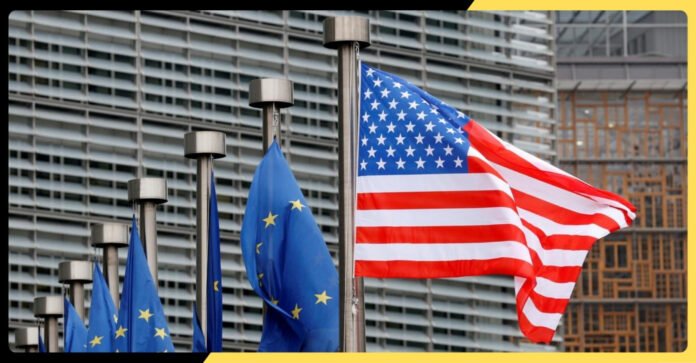

The European Union has issued a stark warning of a potential “downward spiral” in transatlantic relations after former U.S. President Donald Trump threatened to impose new tariffs on European goods, citing strategic and economic disputes linked to Greenland. The remarks, delivered during a campaign-style address and later reinforced through social media statements, have reignited concerns in Brussels over the return of unilateral trade measures and geopolitical brinkmanship.
Greenland, an autonomous territory within the Kingdom of Denmark, has long held strategic importance due to its location in the Arctic and its vast reserves of rare earth minerals. Trump’s renewed focus on the island echoes his controversial 2019 proposal for the United States to purchase Greenland—an idea that was firmly rejected by Denmark and widely criticized across Europe. While the latest statements stop short of suggesting acquisition, they frame Greenland as a symbol of what Trump describes as Europe’s “failure to align with U.S. strategic interests.”
European Commission officials responded swiftly, warning that linking territorial or security disputes to trade policy risks destabilizing not only EU–U.S. relations but also the global trading system. “Tariffs imposed under political pretexts undermine trust and invite retaliation,” said one senior EU trade official. “This is precisely how trade wars begin—and how everyone loses.”
According to diplomats familiar with internal discussions, the EU fears that even the threat of tariffs could chill investment, disrupt supply chains, and fuel market uncertainty at a time when the global economy remains fragile. Inflationary pressures, energy market volatility, and ongoing geopolitical conflicts have already placed strain on European economies, making the prospect of new trade barriers particularly unwelcome.
Trump’s comments suggest that tariffs could be levied on European steel, aluminum, and high-value manufactured goods unless European governments demonstrate greater cooperation on Arctic security and resource access. Analysts note that such measures would mirror Trump’s earlier use of national security justifications under Section 232 of U.S. trade law—a move that previously triggered retaliatory tariffs from the EU.
Denmark, placed uncomfortably at the center of the controversy, has sought to de-escalate tensions. Danish officials reiterated that Greenland’s status is non-negotiable and emphasized ongoing cooperation with the United States through NATO and bilateral defense agreements. “Greenland is not a bargaining chip in trade negotiations,” Denmark’s foreign minister said in a statement. “Security cooperation cannot be coerced through economic pressure.”
Within the EU, the episode has reignited debate over strategic autonomy and the bloc’s dependence on the U.S. market. Some member states argue that Europe must prepare for a more transactional Washington by strengthening internal demand and diversifying trade partnerships. Others caution against overreaction, noting that campaign rhetoric does not always translate into policy.
Nevertheless, European leaders remember well the economic impact of the 2018–2020 trade disputes, when tit-for-tat tariffs affected billions of euros in exports and strained political relations. The EU ultimately brought successful legal challenges at the World Trade Organization, but the damage to trust lingered.
Trade experts warn that if tariffs were imposed, the EU would likely respond in kind, targeting politically sensitive U.S. exports such as agricultural products and consumer goods. Such a scenario, they argue, could quickly spiral into a broader confrontation, particularly if combined with disputes over digital taxation, climate regulations, and industrial subsidies.
The European Parliament has called for unity and restraint, urging the Commission to keep diplomatic channels open while preparing proportionate countermeasures. “Europe must be firm but calm,” said one lawmaker. “Escalation serves no one, least of all citizens and businesses on both sides of the Atlantic.”
As uncertainty grows, businesses are watching closely. Major European manufacturers and exporters have urged policymakers to prevent a repeat of past trade wars, warning that higher tariffs would ultimately be passed on to consumers.
Whether Trump’s threat represents a concrete policy direction or a negotiating tactic remains unclear. What is clear, EU officials say, is that weaponizing trade over Greenland risks entangling economic relations in geopolitical disputes—an approach they believe could have lasting consequences well beyond the Arctic.