

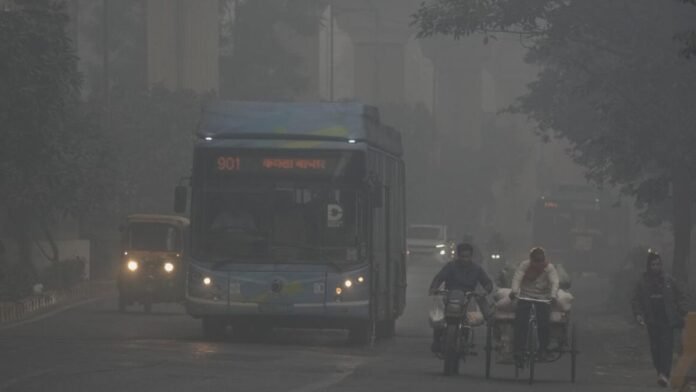

Delhi once again found itself engulfed in a thick blanket of smog as air quality deteriorated sharply, pushing the Air Quality Index (AQI) firmly into the ‘severe’ category. The worsening pollution levels have raised serious concerns among health experts, environmentalists, and policymakers, with authorities scrambling to contain the crisis and residents struggling to cope with hazardous air conditions.
According to air quality monitoring agencies, several parts of the national capital recorded AQI readings well above the safe threshold, with some stations nearing emergency levels. An AQI in the ‘severe’ category indicates that even healthy individuals may experience respiratory distress, while people with pre-existing conditions such as asthma, heart disease, or chronic obstructive pulmonary disease face significantly higher risks.
The spike in pollution has been attributed to a combination of meteorological and human factors. Calm wind conditions, lower temperatures, and high moisture levels have trapped pollutants close to the ground, preventing dispersion. At the same time, emissions from vehicles, construction activities, industrial units, and seasonal biomass burning in neighboring states have contributed to the toxic mix hanging over the city.
Hospitals across Delhi have reported a noticeable increase in patients complaining of breathing difficulties, eye irritation, sore throats, and persistent coughing. Doctors warn that prolonged exposure to such polluted air can lead to long-term health consequences, including reduced lung function, cardiovascular problems, and increased susceptibility to infections. Children and the elderly remain the most vulnerable, prompting many schools to limit outdoor activities.
In response to the deteriorating situation, authorities have intensified the implementation of the Graded Response Action Plan (GRAP). Measures include restrictions on construction and demolition activities, increased mechanized road sweeping, water sprinkling to control dust, and tighter checks on polluting vehicles. The use of diesel generators has been curtailed, and industries running on non-approved fuels have been asked to shut operations temporarily.
Despite these measures, experts argue that short-term emergency responses are not enough. Environmentalists stress the need for sustained, year-round action to address the root causes of Delhi’s pollution. Vehicular emissions continue to be one of the biggest contributors, with the growing number of private vehicles adding to congestion and exhaust fumes. Although public transport has expanded in recent years, many believe it is still insufficient to meet the city’s demand.
Construction dust remains another persistent problem. Even though regulations mandate dust-control measures at construction sites, enforcement is often lax. Open dumping of debris, uncovered materials, and poor compliance exacerbate air quality, especially during winter months when dispersion is limited.
Residents have expressed frustration and fatigue over the recurring pollution crisis. Many have resorted to wearing masks outdoors and using air purifiers indoors, an added financial burden for households. “Every winter it’s the same story,” said a resident of South Delhi. “We plan our lives around pollution levels, which should not be normal in any city.”
The economic cost of air pollution is also substantial. Reduced productivity due to illness, increased healthcare expenditure, and long-term impacts on workforce health place an enormous burden on the economy. Studies have repeatedly shown that air pollution costs India billions annually, with Delhi among the worst-affected cities.
Environmental experts emphasize the importance of regional coordination, as Delhi’s air quality is influenced not just by local emissions but also by pollution from surrounding states. Crop residue burning, in particular, remains a contentious issue, requiring solutions that balance environmental concerns with farmers’ livelihoods. Incentives for alternative crop management techniques and stronger inter-state cooperation are seen as critical steps forward.
As Delhi continues to battle hazardous air, citizens and authorities alike are confronted with a pressing question: how many more winters will pass before clean air becomes a reality? Until comprehensive, long-term strategies are effectively implemented, the city’s struggle against pollution is likely to remain an annual and increasingly severe challenge.