

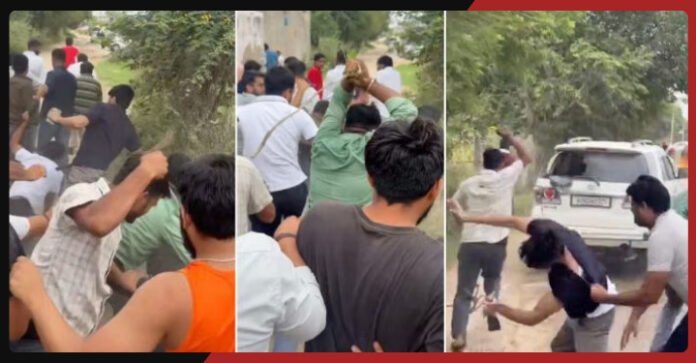

A school-inspection campaign in Rajasthan turned into a political confrontation on Friday after members of the Cockroach Janta Party, or CJP, alleged that they were attacked while attempting to visit a government school in the Jaipur district. CJP founder Abhijeet Dipke claimed that co-convenor Ashutosh Ranka and several volunteers were assaulted during the visit, while vehicles belonging to the group were also allegedly damaged. The allegations have triggered a fresh political dispute over the condition of government schools, political activism and the role of local authorities.
According to reports, the CJP team had travelled to the Rampura-Kanwarpura area as part of its “School Thik Karo” campaign. The campaign has been presented by the organisation as an effort to inspect government schools and document problems involving infrastructure, sanitation, classrooms, toilets, electricity, drinking water and other basic facilities. CJP has said that residents from several parts of Rajasthan contacted the organisation after complaining about poor conditions at government schools.
The situation reportedly became tense when the CJP team reached the area. Videos circulating in connection with the incident show a group of people confronting members of the organisation. Another report said locals chased away members of the CJP team and that some vehicles were damaged during the confrontation. The precise sequence of events and responsibility for individual acts of violence remain disputed.
Dipke alleged that people associated with the Bharatiya Janata Party were behind the incident. He accused the alleged attackers of targeting CJP volunteers because they were attempting to inspect and document the condition of a government school. He also questioned the role of the Rajasthan Police, alleging that officers failed to adequately protect the CJP team. These remain allegations made by the CJP and have not been independently established.
Ranka also described the incident as an assault on the campaign. He reportedly said that the CJP team had intended to inspect a school that had allegedly been functioning from a buffalo shed for years. The organisation has used such claims to argue that government-school infrastructure needs greater public scrutiny.
However, the incident has another side. Local villagers have disputed the CJP’s version of events. Reports indicate that some residents opposed the visit and argued that the school’s problems were already being addressed. Villagers reportedly pointed to government funding of around Rs 12.5 lakh for the school and questioned why an outside political organisation was attempting to intervene.
The confrontation comes after the Rajasthan Education Department recently restricted unauthorised entry, photography, videography, interviews and live-streaming inside government schools. The department said the restrictions were intended to protect students’ privacy, dignity and safety. The timing of the order, coming shortly after the CJP announced its school-inspection campaign, has nevertheless created controversy.
The latest confrontation has therefore widened an already heated debate. For CJP, the incident is evidence that activists attempting to highlight problems in government schools are facing resistance. For critics of the campaign, the episode raises questions about whether political organisations should conduct inspections of schools without official permission.
The controversy is now likely to focus on two issues: the actual condition of the school involved and whether violence or intimidation occurred during the visit. Any formal police investigation or administrative inquiry could help establish what happened.
For students and parents, however, the larger issue remains education. Political arguments may dominate the headlines, but the underlying questions are straightforward: Do schools have safe buildings? Are toilets functional? Is drinking water available? Are teachers present in adequate numbers? And are children studying in a safe environment?
The CJP has vowed to continue its campaign, while Rajasthan authorities have already tightened rules concerning school access. The confrontation could therefore become an important test of how citizen-led scrutiny and government control over educational institutions coexist in the state.