

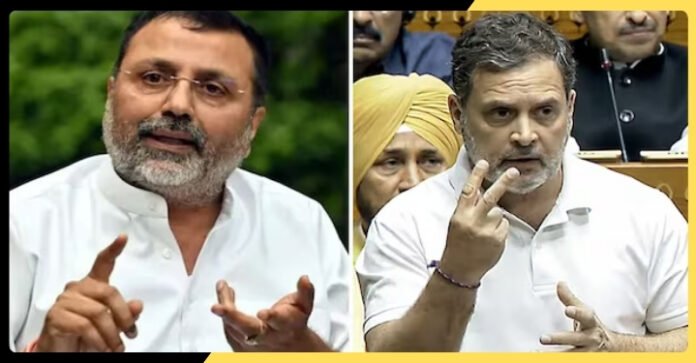

A fresh political controversy has erupted in New Delhi after a Bharatiya Janata Party (BJP) Member of Parliament initiated formal steps seeking the disqualification of Congress leader Rahul Gandhi from the Lok Sabha. The move marks the beginning of what could become another high-stakes confrontation between the ruling party and the principal opposition.
The BJP MP reportedly submitted a written complaint to the Speaker of the Lok Sabha, citing specific grounds under parliamentary rules and constitutional provisions. While the precise details of the complaint have not been officially disclosed in full, party sources indicate that the request is linked to statements or actions allegedly deemed inconsistent with parliamentary norms or constitutional obligations.
Under Indian law, the disqualification of an MP can occur under several circumstances, including conviction in certain criminal cases, defection under the Tenth Schedule (anti-defection law), holding an office of profit, or violating specific constitutional provisions. Any such process typically requires examination by the Speaker, who may seek clarification, documentation, or legal opinion before making a determination.
The Grounds for the Complaint
According to BJP representatives, the complaint argues that Rahul Gandhi’s recent remarks and conduct warrant scrutiny under the rules governing parliamentary conduct. The BJP MP has urged the Speaker to examine whether the Congress leader’s statements undermine the dignity of Parliament or violate constitutional obligations taken under oath.
The BJP has maintained that accountability must apply equally to all lawmakers, regardless of political stature. “No individual is above the Constitution,” a senior BJP leader said while defending the move. “If there has been a breach of privilege, decorum, or constitutional propriety, it must be examined as per due process.”
Congress, however, has strongly condemned the action, describing it as politically motivated and an attempt to silence opposition voices. Party leaders have accused the BJP of using procedural tools to target critics and distract from substantive policy debates.
Congress Hits Back
Senior Congress leaders swiftly rallied behind Rahul Gandhi, asserting that the complaint lacks merit and is intended to create headlines rather than uphold parliamentary ethics. They argue that robust debate and criticism are integral to democratic functioning and that opposition leaders have the right—indeed, the responsibility—to question the government.
“This is nothing but intimidation politics,” a Congress spokesperson said. “Whenever Rahul Gandhi raises issues concerning governance, accountability, or national interest, we see attempts to target him personally. The public can see through this pattern.”
Rahul Gandhi himself has not issued a detailed public statement regarding the latest complaint but has consistently defended his remarks in past controversies as being rooted in democratic principles and freedom of expression.
The Role of the Speaker
The Speaker of the Lok Sabha plays a central role in any disqualification proceedings. Upon receiving a complaint, the Speaker may review its admissibility and determine whether a prima facie case exists. If required, the concerned MP is given an opportunity to respond. The process can vary in length depending on the complexity of the matter and the legal questions involved.
In politically sensitive cases, the Speaker’s decision often attracts intense scrutiny. Past disqualification proceedings in India have sometimes led to judicial challenges, with courts examining whether constitutional procedures were followed correctly.
Legal experts note that the threshold for disqualification is specific and cannot be based merely on political disagreement. “Parliamentary democracy allows for sharp criticism and debate,” said a constitutional law scholar. “For disqualification to occur, there must be a clear and demonstrable violation of the Constitution or statutory provisions.”
A History of Political Confrontation
The relationship between Rahul Gandhi and the BJP leadership has long been marked by confrontation. As one of the most prominent faces of the opposition, Gandhi has frequently criticized the government on issues ranging from economic policy and unemployment to foreign affairs and institutional independence.
In recent years, several disputes involving his speeches—both inside and outside Parliament—have triggered heated exchanges. At times, remarks have been expunged from parliamentary records or referred to privilege committees for examination.
Political analysts observe that such confrontations often intensify ahead of major electoral cycles, as parties seek to consolidate their respective support bases. Moves like disqualification petitions, even if they do not ultimately succeed, can become part of broader political messaging strategies.
Implications for Parliament
If the Speaker admits the complaint and initiates proceedings, it could lead to prolonged debate within political circles and possibly within Parliament itself. Opposition parties may rally in solidarity, framing the move as an attack on democratic dissent. The ruling party, meanwhile, is likely to emphasize adherence to parliamentary standards.
The development also underscores the increasingly combative tone of Indian politics. Parliamentary disruptions, privilege notices, and formal complaints have become more frequent tools in the arsenal of both ruling and opposition parties.
For the functioning of Parliament, such episodes can either reinforce procedural accountability or contribute to legislative gridlock, depending on how they unfold. Much will depend on whether the matter proceeds swiftly through established mechanisms or becomes entangled in legal and political wrangling.
What Happens Next?
At this stage, the process remains at its preliminary phase. The Speaker’s office is expected to review the complaint before deciding on further steps. Rahul Gandhi, if formally notified, will have the opportunity to present his defense.
Political observers caution against premature conclusions. “Filing a complaint is the first step, but disqualification is a serious measure,” said a parliamentary affairs expert. “The bar is high, and due process must be followed.”
As the situation develops, it is likely to intensify debates about freedom of speech, accountability, and the boundaries of parliamentary conduct. Whether this move results in substantive action or remains a symbolic political gesture will depend on the procedural and legal path it takes in the coming days.
For now, the bid by the BJP MP marks the opening chapter of another chapter in the ongoing political rivalry between the ruling party and one of its most prominent critics—an episode that will be closely watched across the country.