

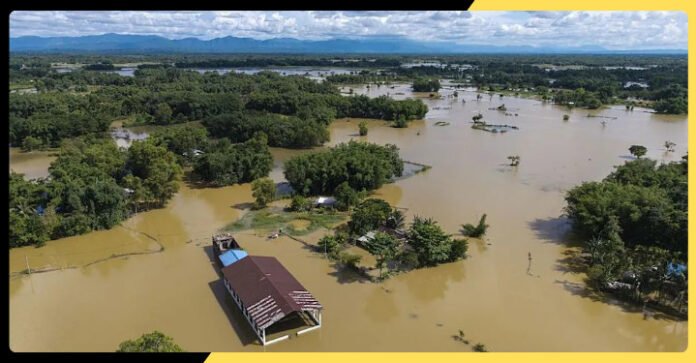

The northeastern Indian state of Assam is once again battling one of its most severe flood disasters in recent years, leaving thousands of families homeless, destroying livelihoods, and exposing the region’s long-standing vulnerability to extreme weather. Continuous heavy rainfall across Assam and neighbouring states, combined with overflowing rivers, has submerged hundreds of villages and forced residents to abandon everything they owned in search of safety.
For many families, the floods arrived with little warning. Rivers such as the Brahmaputra and its tributaries rose rapidly after days of relentless monsoon rainfall, breaching embankments and inundating homes, roads, schools, and farmland. Entire communities woke up to find water entering their houses, leaving them only enough time to gather a few belongings before escaping to higher ground.
Local authorities launched rescue operations using boats, while disaster response teams, the Indian Army, and the National Disaster Response Force (NDRF) worked tirelessly to evacuate stranded residents. Temporary relief camps were established across affected districts, providing food, drinking water, medical care, and shelter for displaced families. However, overcrowding and limited resources have created additional challenges, particularly for children, elderly citizens, and people with medical conditions.
The economic impact has been equally devastating. Agriculture, the backbone of Assam’s rural economy, has suffered enormous losses. Thousands of hectares of paddy fields have been submerged, destroying crops just weeks before harvest. Farmers who had invested their savings into seeds, fertilisers, and irrigation now face financial uncertainty, with many fearing they will struggle to recover without government assistance.
Livestock losses have further worsened the situation. Cattle, goats, poultry, and other animals have either drowned or become stranded without access to food and clean water. For many rural households, livestock represents a crucial source of income, making these losses especially painful.
Education has also been severely disrupted. Schools in flood-hit districts have either been damaged or converted into emergency relief centres, forcing students to suspend their studies. Teachers and volunteers are attempting to support displaced children through temporary learning spaces, but restoring normal education remains a major challenge.
Healthcare services face growing pressure as floodwaters increase the risk of waterborne diseases such as diarrhoea, cholera, and skin infections. Medical teams are conducting health camps, distributing medicines, and encouraging safe drinking water practices to prevent disease outbreaks. Mosquito-borne illnesses are another concern as stagnant water creates ideal breeding conditions.
Infrastructure across several districts has sustained extensive damage. Roads, bridges, electricity lines, and communication networks have been disrupted, making relief operations more difficult. Transportation of essential supplies has slowed in many remote areas where floodwaters remain high.
Environmental experts point out that Assam experiences annual flooding because of its geographical location along the Brahmaputra River system. However, changing rainfall patterns linked to climate change, combined with deforestation, riverbank erosion, and increased sediment deposition, have intensified the severity of recent floods.
Government agencies have announced financial assistance for affected families while continuing rescue and rehabilitation efforts. Relief materials, including food grains, drinking water, clothing, blankets, and essential medicines, are being distributed across the worst-hit regions. Authorities are also assessing infrastructure damage to prepare long-term reconstruction plans.
Despite the widespread destruction, stories of resilience continue to emerge. Volunteers, local organisations, students, and community groups have joined hands to support flood victims by distributing meals, rescuing stranded animals, and collecting donations. Their efforts have provided hope during one of the state’s darkest moments.
As floodwaters gradually begin to recede in some areas, the difficult task of rebuilding lies ahead. Thousands of families will need new homes, farmers will require financial support to restart cultivation, and damaged infrastructure must be restored. The disaster has once again highlighted the urgent need for stronger flood management systems, climate-resilient infrastructure, and sustainable environmental planning.
For the people of Assam, recovery will not happen overnight. Yet their determination to rebuild their lives remains stronger than the floodwaters that swept through their communities.