

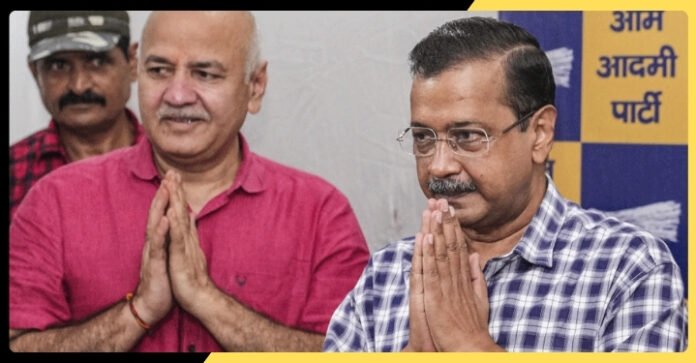

In a significant development in the Delhi excise policy case, a Delhi court on Tuesday discharged all accused, including Chief Minister Arvind Kejriwal and former Deputy Chief Minister Manish Sisodia, delivering a sharp rebuke to the Central Bureau of Investigation (CBI) for what it termed serious procedural lapses in the probe. The decision marks a major turning point in a case that has dominated political discourse for months and intensified the confrontation between the ruling Aam Aadmi Party (AAP) and the central government.
The court, while pronouncing its order, observed that the investigating agency had failed to present sufficient and legally sustainable evidence to justify framing charges against the accused. It noted that the material placed on record did not meet the threshold required to proceed to trial. In its remarks, the court underscored inconsistencies in the documentation and pointed out gaps in the chain of evidence that undermined the prosecution’s case.
The excise policy case revolved around alleged irregularities in the formulation and implementation of Delhi’s 2021–22 liquor policy. The CBI had alleged that the policy was manipulated to benefit certain private entities in exchange for kickbacks. Several AAP leaders were named in the investigation, with Sisodia’s arrest becoming one of the most politically consequential moments of the controversy. Kejriwal, too, faced intense scrutiny as the alleged conspiracy was said to have originated at the highest levels of government.
However, during the hearings on discharge applications, defense counsel argued that the case was built on conjecture rather than concrete proof. They maintained that policy decisions, even if later withdrawn, did not automatically amount to criminal misconduct. The court appeared to agree, emphasizing that suspicion, however strong, cannot replace evidence in criminal proceedings.
Importantly, the judge criticized the CBI for procedural oversights, including what was described as a failure to adequately corroborate statements and properly establish a money trail. The court stressed that investigative agencies must adhere to strict standards of fairness and thoroughness, particularly in high-profile cases with far-reaching political implications.
Following the order, AAP leaders hailed the ruling as a vindication of their long-standing claim that the case was politically motivated. Party spokespersons asserted that the discharge exposed what they described as misuse of central agencies to target opposition leaders. Celebrations erupted among party workers, who framed the court’s decision as a victory for democratic accountability.
The CBI, meanwhile, indicated that it would review the order and consider its legal options, including the possibility of filing an appeal in a higher court. Legal experts note that discharge at this stage does not necessarily mark the end of proceedings, as appellate remedies remain open.
The ruling has immediate political consequences. With elections approaching, the decision is likely to influence campaign narratives both in Delhi and nationally. While the opposition will portray the discharge as proof of overreach by central authorities, the ruling party at the Centre may seek to emphasize that judicial processes were allowed to run their course.
Ultimately, the court’s order reinforces a foundational principle of criminal jurisprudence: that prosecution must rest on solid evidence, not assumption. As the dust settles, the case will continue to resonate in debates over federal power, investigative accountability, and the intersection of law and politics in India.