

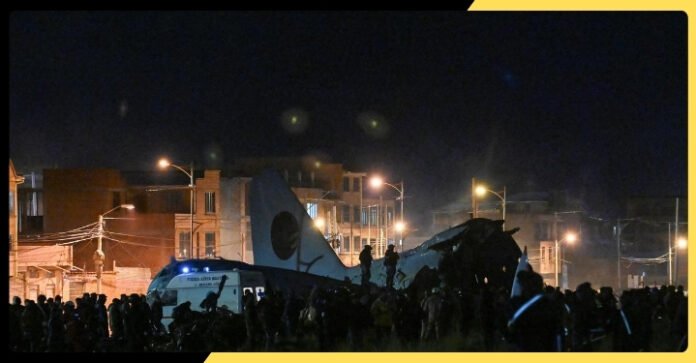

A military aircraft transporting large shipments of banknotes crashed Wednesday on the outskirts of La Paz, leaving at least 20 people dead in one of the deadliest aviation disasters in the country’s recent history. Authorities confirmed that the plane, operated by the Bolivian Air Force, went down shortly after takeoff during what officials described as a routine logistics mission.
The aircraft had been tasked with transporting newly printed currency on behalf of the Central Bank of Bolivia to regional branches across the country. According to preliminary reports, the plane experienced technical difficulties minutes after departure from El Alto International Airport. Witnesses reported hearing a loud sputtering noise before the aircraft rapidly lost altitude and crashed into a densely populated neighborhood.
Emergency responders arrived within minutes, battling flames and thick smoke as residents attempted to rescue survivors from the wreckage. Officials confirmed that all crew members aboard the aircraft were killed, along with several civilians on the ground. Dozens more were injured, some critically, and were transported to nearby hospitals.
Local authorities have launched a full-scale investigation into the cause of the crash. Early speculation has focused on possible engine failure, though investigators cautioned against drawing conclusions before examining the flight data recorder and maintenance logs. Defense Ministry representatives stated that the aircraft had undergone routine inspections prior to departure and had no documented mechanical issues.
The tragedy has reignited debate over the condition and age of the country’s military transport fleet. Aviation experts noted that some aircraft in service date back several decades, raising concerns about ongoing maintenance standards and funding constraints.
Meanwhile, security forces cordoned off the crash site to prevent looting, as scattered banknotes were reportedly found among the debris. Officials assured the public that measures were being taken to secure the currency and account for any losses. The Central Bank emphasized that the destroyed shipment represented insured funds and would not disrupt financial operations.
Presidential officials expressed condolences to the victims’ families and declared three days of national mourning. Flags were lowered to half-staff at government buildings, and a memorial service is expected later this week.
Residents of La Paz described scenes of chaos and heartbreak. “We heard an explosion and then everything shook,” said one witness. “When we ran outside, there was fire everywhere.”
As investigators work to determine what went wrong, the nation faces painful questions about aviation safety and accountability. For now, families grieve and a community struggles to come to terms with a disaster that unfolded in seconds but will leave lasting scars for years to come.