

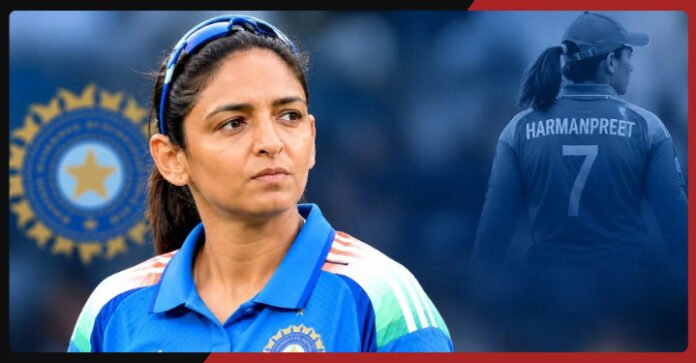

Harmanpreet Kaur has stepped down as captain of the Indian women’s cricket team across all three formats, bringing an end to one of the most significant leadership eras in the history of Indian women’s cricket. The 37-year-old announced her decision on October 6, shortly after a Board of Control for Cricket in India (BCCI) review meeting in Guwahati that assessed the team’s recent performances and discussed its future direction.
The decision marks the conclusion of a captaincy journey that began in the shortest format in 2016 and later expanded across ODI and Test cricket. Harmanpreet became India’s full-time ODI and Test captain in 2022 after Mithali Raj’s retirement and subsequently took charge of all formats. Over the years, she became one of the most recognisable faces of Indian women’s cricket and played a major role in the sport’s growth in the country.
Harmanpreet announced the decision in an emotional social media statement. She described stepping away from captaincy as a difficult decision filled with memories, emotions and sacrifices. She also made it clear that her departure from the leadership role does not mean the end of her international career. Instead, she intends to continue representing India as a player.
The timing of the announcement was significant. The BCCI review meeting in Guwahati was chaired by BCCI secretary Devajit Saikia and attended by Harmanpreet, vice-captain Smriti Mandhana and head coach Amol Muzumdar. The meeting was held to evaluate the team’s trajectory and consider the roadmap for the future.
Harmanpreet leaves the captaincy with an extraordinary record of achievements. Most notably, she led India to their first-ever Women’s ODI World Cup title. That historic triumph established her as the first Indian woman to captain the senior national team to an ICC World Cup title. Her leadership era also included major successes at the Asian Games, where India secured consecutive gold medals in women’s cricket.
Her tenure was not without difficult periods. Like any long-serving captain, Harmanpreet faced criticism, pressure and questions over performances and tactical decisions. She acknowledged in her farewell message that captaincy involved difficult choices, some of which came at a personal cost.
She also indicated that leadership sometimes required her to put her own individual ambitions and performance aside for the benefit of the team. According to her, her primary objective was always to create a stronger side and help younger players develop confidence and reach their potential.
The end of her captaincy therefore represents more than a change in leadership. It signals the beginning of a new phase for Indian women’s cricket. Smriti Mandhana is widely regarded as the leading candidate to take over the captaincy, although the final decision rests with the BCCI and team management.
For Harmanpreet herself, the next chapter could provide an opportunity to concentrate entirely on her cricket without the additional responsibilities that come with leading an international team. Her statement suggested that she is looking forward to playing simply for her love of the game again.
Her contribution to Indian cricket extends well beyond statistics. She was part of the generation that helped transform women’s cricket from a niche sporting product into one of India’s most followed sporting competitions. Her aggressive batting, competitive personality and leadership made her an important figure during that transformation.
Harmanpreet’s decision also comes at a potentially important moment for the Indian team. With a new generation of players emerging and major international competitions ahead, the transition in leadership will be closely watched.
Yet her message was not one of regret. Instead, it reflected a sense of fulfilment. She said she believed the team was in a good place, with talent, character, belief and a promising future.
The captaincy chapter may have closed, but Harmanpreet Kaur’s international cricket journey continues. Her next role will be different, but her experience and influence are likely to remain valuable to the Indian dressing room.
For Indian women’s cricket, meanwhile, the challenge is to build upon the foundations laid during her leadership while successfully entering a new era. Harmanpreet leaves the captaincy after years of responsibility, major victories and historic achievements — and now gets the chance to focus once again on the player behind the captain.