

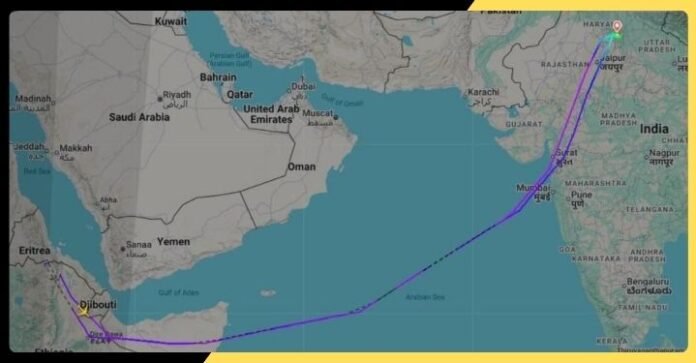

The promise of a new long-haul connection between India and the United Kingdom took an unexpected turn when an IndiGo flight from Delhi to Manchester ended up returning to its point of origin after nearly 14 hours in the air. The incident highlighted both the complexities of long-distance aviation and the unpredictability that airlines must constantly manage.
The flight, operated by IndiGo, had departed from Indira Gandhi International Airport in New Delhi with its destination set for Manchester Airport in the United Kingdom. For passengers onboard, it was expected to be a straightforward journey connecting India’s capital with one of northern England’s major cities. Instead, the trip transformed into an exhausting loop across continents.
Midway through the journey, the aircraft encountered circumstances that prevented it from completing the route as scheduled. While airlines typically do not disclose every operational detail, such disruptions can be triggered by factors ranging from technical checks and weather complications to airport slot limitations or airspace restrictions.
In aviation, safety protocols dictate that any anomaly—no matter how minor—must be evaluated thoroughly. If the crew determines that continuing to the destination could compromise safety or create operational complications, turning back to the departure airport is often the most controlled and predictable option.
Passengers onboard reportedly spent close to 14 hours in the air before landing back in Delhi, effectively completing an ultra-long flight without reaching their destination. For many travelers, the experience was both frustrating and bewildering. A journey expected to end in Manchester instead concluded exactly where it had begun.
Airlines face unique challenges on long-haul routes such as Delhi–Manchester. Unlike shorter regional flights, long-distance operations require careful planning for fuel loads, crew duty limits, diversion airports, and real-time weather monitoring across several countries. Even minor issues early in the flight can cascade into larger operational constraints later in the journey.
For IndiGo, which built its reputation primarily as a low-cost carrier focused on domestic and short-haul international routes, the expansion into longer flights represents a significant strategic step. Long-haul routes require different logistics, fleet capabilities, and contingency planning.
Events like this, while rare, are not unprecedented in global aviation. Aircraft sometimes return to their origin due to mechanical alerts, medical emergencies, or restrictions at destination airports. In many cases, such decisions reflect a cautious approach rather than a failure of systems.
After the aircraft returned safely to Delhi, airline teams typically begin a coordinated response: inspecting the aircraft, rebooking passengers, arranging accommodations if necessary, and preparing a replacement flight or alternative travel options.
For passengers, the experience may have felt like a journey to nowhere. For aviation professionals, however, it was a demonstration of a fundamental principle of air travel—when uncertainty arises at 35,000 feet, the safest destination can sometimes be the one you started from.