

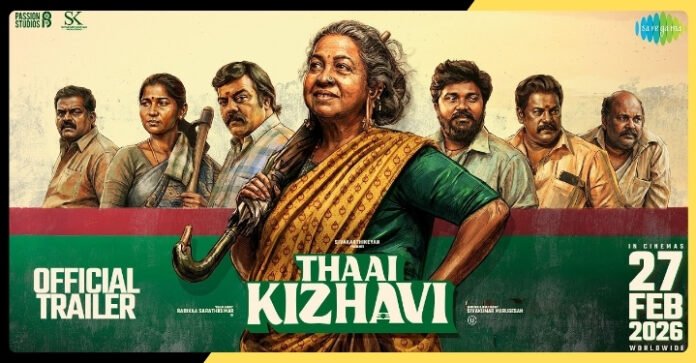

In Thaai Kizhavi, Radikaa Sarathkumar doesn’t merely headline a film — she anchors a celebration. This masala comedy, glittering with gold and grounded in generational pride, arrives as both a star vehicle and a statement of intent from a filmmaker who understands tone, rhythm and audience appetite. What could have easily slipped into caricature instead blossoms into a riotous yet affectionate tribute to matriarchal authority.
The premise is deliciously simple: a formidable elderly woman presides over her family and business empire with the decisiveness of a monarch and the theatricality of a ringmaster. Gold — literal and metaphorical — flows through every frame. It is currency, inheritance, temptation and power. Yet beneath the comedic bluster lies a sharp meditation on legacy and self-worth.
Radikaa plays the titular Thaai Kizhavi with relish. Draped in resplendent silks and weighed down by unapologetically ostentatious jewellery, she commands attention from her first entrance. But the performance is not just decorative. She modulates her energy with precision — barked orders soften into wry humour; stern glances dissolve into vulnerability when confronted with familial betrayal. The script wisely allows her moments of stillness, and it is in these quieter beats that the character acquires dimension.
The film’s humour operates on multiple frequencies. There is slapstick — doors slammed, secrets overheard, conspirators foiled at the worst possible moment. There is verbal wit, much of it delivered in rapid-fire exchanges that highlight generational differences. And then there is situational irony: schemes to outsmart the matriarch inevitably collapse because she is always three steps ahead. The writing revels in exaggeration but never fully abandons emotional logic.
Visually, the film leans into maximalism. Interiors gleam with polished marble and gold-plated fixtures, creating a heightened reality that mirrors the protagonist’s larger-than-life persona. Costume design becomes storytelling; every necklace layered around Thaai Kizhavi’s neck feels like a chapter of history. The director’s framing frequently places her at the centre of symmetrical compositions, reinforcing her authority within the domestic kingdom she rules.
Yet the narrative is not solely concerned with spectacle. At its heart lies a familiar but resonant conflict: succession. Children and grandchildren hover around the matriarch, some dutiful, others opportunistic. The film cleverly mines comedy from their impatience. They view gold as liquid wealth; she sees it as memory cast in metal. This generational clash provides the story with stakes beyond simple inheritance.
The supporting cast plays their parts with spirited commitment. The younger characters oscillate between entitlement and earnestness, embodying a modern restlessness that contrasts sharply with the grandmother’s old-school pragmatism. Their arcs are not overly complex, but they are sufficient to sustain narrative momentum. Importantly, none of them upstage the central performance — a testament to both casting and direction.
Music pulses through the film like an additional character. Traditional rhythms collide with contemporary beats, mirroring the thematic tug-of-war between past and present. Dance sequences are staged with flamboyance, yet they avoid feeling like interruptions. Instead, they reinforce the communal atmosphere that defines the story’s emotional terrain.
What distinguishes this masala outing from routine commercial fare is its tonal discipline. The director understands that comedy must emerge from character rather than chaos. Even when scenes teeter on absurdity, they are anchored by Thaai Kizhavi’s unwavering internal logic. She may indulge in theatrics, but she is never foolish. In fact, the film’s most satisfying moments arrive when her calculated patience exposes the shortsightedness of those around her.
There are, admittedly, indulgences. Certain subplots stretch credibility, and a climactic twist leans heavily on melodrama. Yet these excesses feel almost genre-mandated. The film embraces the masala tradition — an unapologetic blend of humour, sentiment and spectacle — while injecting it with a distinctly feminine centre of gravity.
Radikaa’s performance ultimately elevates the enterprise. She refuses to reduce the character to either saintly grandmother or comic tyrant. Instead, she crafts a portrait of authority shaped by sacrifice and sharpened by experience. Her laughter carries warmth; her reprimands carry history. By the final act, when the matriarch asserts her vision for the family’s future, the moment resonates not because of narrative surprise but because of earned emotional weight.
“Thaai Kizhavi” signals a filmmaker confident in balancing homage and reinvention. It acknowledges the pleasures of commercial Tamil cinema while carving space for a commanding female protagonist who refuses to fade into the background. Gold may glitter throughout, but it is character — burnished, resilient and unapologetically bold — that proves the film’s most enduring treasure.