

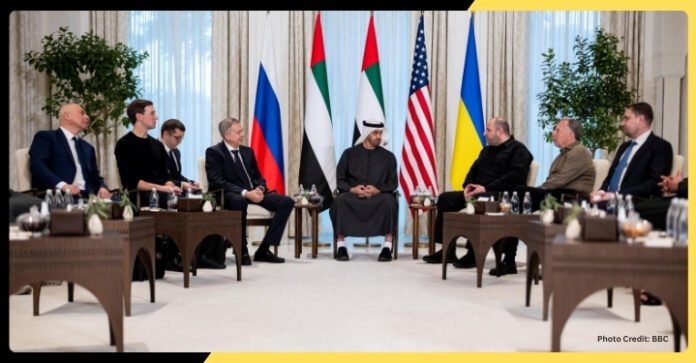

Abu Dhabi, the capital of the United Arab Emirates, has become the stage for a renewed diplomatic push as Russia and Ukraine returned to peace talks on February 4–5, 2026. The second round of trilateral negotiations, brokered by the United States, aims to address unresolved issues from earlier discussions and explore potential pathways to end nearly four years of intense conflict. The talks are occurring amidst ongoing hostilities and a fragile humanitarian situation, raising both hope and skepticism among international observers.
Background: The Conflict and Prior Negotiations
The war in Ukraine, initiated by Russia’s full-scale invasion in February 2022, has resulted in significant loss of life, massive displacement, and extensive destruction of infrastructure. Key areas in eastern and southern Ukraine, including the Donetsk, Luhansk, Kherson, and Zaporizhzhia regions, remain under Russian occupation, and both sides have engaged in prolonged combat despite intermittent ceasefires.
Initial efforts to negotiate peace were sporadic and largely unsuccessful, with early rounds of diplomacy failing to produce concrete results on core disputes such as territorial control, security guarantees, and accountability mechanisms. In January 2026, the first U.S.-brokered talks in Abu Dhabi offered a platform for dialogue but ended without substantive agreements, leaving the stage for the second round.
Arrival of Delegations and Opening Statements
The delegations from Russia and Ukraine arrived in Abu Dhabi under tight security and amid high international attention. Ukraine’s team, led by Rustem Umerov, head of Ukraine’s National Security and Defence Council, emphasized the importance of maintaining Ukrainian sovereignty and securing binding international guarantees. Russia’s delegation, including senior military and diplomatic officials, continued to insist on territorial concessions and recognition of areas Moscow annexed.
U.S. envoys, mediating the talks, stressed the need for constructive engagement and incremental progress, framing the discussions as a potential opportunity to reduce hostilities and prevent further escalation. Emirati officials have highlighted Abu Dhabi’s neutral position as key to facilitating dialogue, noting the UAE’s previous role in supporting humanitarian operations and prisoner exchanges.
Challenges Ahead: Military Pressure and Mutual Distrust
The timing of the second round coincides with intensified military activity. Just days before the Abu Dhabi meeting, Russia launched large-scale missile and drone attacks targeting Ukraine’s energy infrastructure, disrupting power and heating for thousands of civilians during winter. Ukrainian President Volodymyr Zelenskyy publicly condemned the strikes, questioning Moscow’s commitment to peace while signaling that Ukraine would adjust its negotiating stance in response.
Analysts warn that ongoing military operations and reciprocal distrust complicate the diplomatic process. For Ukraine, agreeing to any territorial concessions without strong international guarantees is politically unacceptable. For Russia, perceived threats from NATO expansion and foreign military support to Ukraine remain a central concern. This mutual suspicion underscores the difficulty of achieving meaningful compromises even in a neutral setting.
Key Points of Negotiation
Three central issues dominate the discussions:
- Territorial Status:
Russia continues to demand formal recognition of territories it occupies, including parts of the Donbas region, Kherson, and Zaporizhzhia. Ukraine has consistently rejected any enforced withdrawal or recognition of annexed regions, maintaining that sovereignty cannot be compromised. - Security Guarantees:
Kyiv seeks binding security assurances from the West to prevent future aggression, including legal frameworks and potential international monitoring. Russia opposes such measures, arguing they would entrench foreign military presence near its borders and exacerbate regional tensions. - Ceasefire Compliance:
Establishing a reliable ceasefire mechanism is critical to reducing civilian casualties and facilitating humanitarian access. However, prior ceasefires have been undermined by attacks on both sides, making trust and verification key obstacles.
International Perspectives and U.S. Mediation
The United States has taken a prominent role as mediator, balancing diplomatic pressure on Russia with ongoing military and economic support for Ukraine. U.S. envoys have highlighted areas of potential compromise, emphasizing humanitarian relief, localized ceasefires, and confidence-building measures. European partners continue to support Ukraine but remain cautious, urging diplomacy while maintaining sanctions and defense assistance to deter further Russian aggression.
The UAE’s involvement reflects its growing role as a neutral facilitator in global conflicts. By hosting the talks in Abu Dhabi, the UAE aims to provide a secure environment for dialogue while leveraging its diplomatic relationships with both Moscow and Kyiv. This approach underscores the increasing importance of non-Western intermediaries in modern conflict resolution.
Prospects and Risks
While the Abu Dhabi talks provide a platform for renewed dialogue, analysts caution that major breakthroughs remain uncertain. Both parties face domestic and international pressures that constrain flexibility. For Ukraine, any agreement perceived as compromising sovereignty could provoke public backlash. For Russia, concessions may be politically unpalatable given internal narratives about territorial integrity and national pride.
Nonetheless, even limited progress could carry meaningful benefits, such as temporary reductions in hostilities, improved humanitarian access, and the establishment of mechanisms for continued communication. International observers hope that sustained engagement could gradually build trust, clarify positions, and lay the groundwork for a more comprehensive settlement in the future.
Conclusion
As the second round of Russia-Ukraine peace talks unfolds in Abu Dhabi, the world watches cautiously. The combination of ongoing military escalation, deep-rooted territorial disputes, and mutual distrust presents formidable obstacles, yet the diplomatic effort demonstrates a continued international commitment to seeking resolution. While immediate results may be limited, the discussions could play a vital role in shaping the next phase of conflict management, signaling that dialogue—however fragile—remains a critical tool in addressing one of the most devastating wars in Europe in recent memory.